What Happens If You Quit Your Job While Your Visa Application Is Pending in Japan?
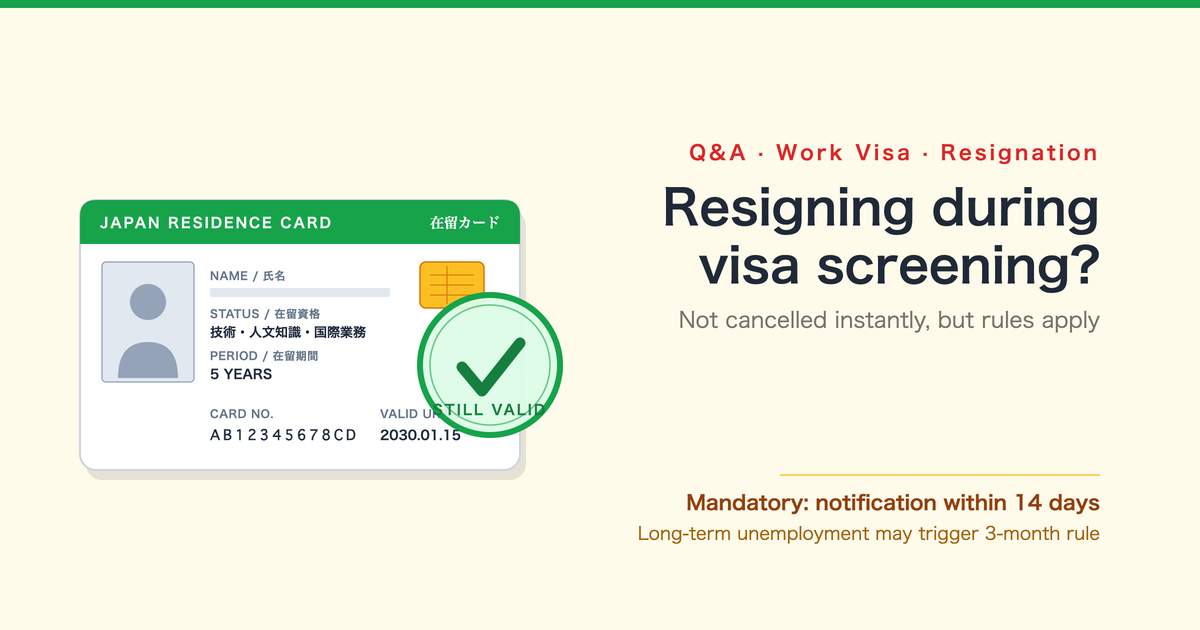
If you are living in Japan on a work visa, you may have wondered about situations like these.
“What happens if I quit my job after submitting a visa renewal application?”
“Will my visa be cancelled immediately if I leave my company?”
“I’m in the middle of a job search — do I need to notify immigration?”
With job changes becoming increasingly common, more and more people find themselves resigning during a visa application or shortly after a visa renewal.
This article explains what actually happens to your status of residence when you resign while holding a Japanese work visa.
Resigning from a Company Does Not Immediately Cancel Your Visa
This is one of the most common misconceptions.
A Japanese work visa is granted based on your status of residence, not tied to a specific employer.
This means your visa is not cancelled the very next day after you leave a company.
For example, holders of work-category statuses of residence such as:
- Engineer / Specialist in Humanities / International Services (技術・人文知識・国際業務)
- Highly Skilled Professional (高度専門職)
- Specified Skilled Worker (特定技能)
will not have their residence card invalidated immediately upon resignation.
However, Staying Unemployed for an Extended Period Can Become a Problem
Resigning itself is not the issue.
The concern arises when you remain completely inactive for a long time after leaving your job.
The Immigration Services Agency can verify whether someone holding a work visa is actually engaged in employment activities.
If it becomes apparent that you:
- Have been unemployed for an extended period after resigning
- Are not conducting any job search activities
- Have no intention of working
this could become a problem.
The Commonly Cited “3-Month Rule”
One of the most frequently heard terms when someone on a work visa resigns is the “3-month rule”.
Under Japan’s Immigration Control Act, a person may become subject to status of residence cancellation if they go three months or more without engaging in activities that correspond to their status of residence.
However, contrary to what many people assume, this does not mean:
“Your visa is automatically cancelled three months after you quit.”
The Immigration Services Agency makes a comprehensive assessment of the actual circumstances.
For example, the following situations may be evaluated differently:
- You are actively conducting a job search
- There are special circumstances such as illness
If You Are Actively Looking for a New Job, It Is Usually Not a Major Problem
In practice, many people are searching for their next position after leaving a company.
If you are:
- Preparing for a career change
- Going through interviews
- Actively engaged in job-hunting activities
it generally does not become a significant problem in most cases.
What matters most is:
“Do you have the intention to work, and are you actively pursuing that?”
You Must Submit a Resignation Notification
This is something many foreign nationals overlook.
When a person holding a work visa leaves their employer, they have a notification obligation to the Immigration Services Agency.
This is referred to as notification of organization (所属機関に関する届出).
In principle, you must submit this notification within 14 days of your resignation.
You Must Also Notify When Joining a New Company
A notification is also required when you start at a new employer.
In other words, both of the following must be submitted:
- Notification of resignation
- Notification of joining a new company
Online submission is also available, which has made the process more convenient.
What Happens If You Resign While a Visa Renewal Application Is Pending?
The situation can vary depending on the circumstances.
For example, if you:
- Have submitted a visa renewal application
- Are waiting for the review to complete
- Resign from your company
the Immigration Services Agency may request additional documents.
In particular, they may verify:
- The fact of your resignation
- Your plans for new employment
- Whether you intend to change jobs
For this reason, trying to conceal a resignation is not a good idea. For guidance on when to start preparing for your visa renewal, see When Should You Start Preparing for Your Japan Visa Renewal?.
What If You Resign Shortly After a Visa Renewal Is Approved?
This is actually quite common.
For example, some people:
- Complete their visa renewal
- Receive a 3-year or 5-year permission
- Then change jobs shortly afterward
This is not illegal in itself.
However, you are still required to properly submit both the resignation notification and the new employment notification.
Can You Continue Living in Japan After Resigning?
In many cases, yes.
As long as your current period of stay has not expired, you are not required to leave the country immediately.
That said, remaining unemployed for an extended period can create complications, so it is advisable to make your next plans as quickly as possible.
What If You Resign During a Permanent Residency Application?
Resigning while a permanent residency application is under review requires extra caution.
In a permanent residency review, immigration assesses a range of factors including:
- Income
- Employment stability
- Tax payment record
As a result, resigning during the review process may lead to a request for additional documentation.
In particular, an extended period of unemployment could potentially affect the outcome of the review.
What If You Change to a Different Type of Job After Resigning?
You need to verify whether your new duties fall within the scope of your current status of residence.
For example, if you hold an Engineer / Specialist in Humanities / International Services (技術・人文知識・国際業務) visa and your new position involves only:
- Simple manual labor
- Non-professional tasks
this could become a problem.
Therefore, before changing jobs, it is important to confirm that your new duties are compatible with your status of residence. For real-world examples of illegal employment cases that were detected, see Real Cases of Illegal Employment Detection in Japan.
Situations to Be Especially Careful About
The Immigration Services Agency is more likely to raise concerns in the following cases:
- Long-term unemployment after resignation
- Failure to fulfill notification obligations
- False or inaccurate notifications
- No intention to work
- Performing duties that do not match your status of residence
Frequently Asked Questions
Will my visa be cancelled immediately if I quit my job?
No.
Your visa is not cancelled the moment you resign.
How many months after resigning is it still okay?
There is no automatic cancellation provision, but remaining inactive for an extended period can become a problem.
What happens if I don’t submit a resignation notification?
Failing to notify is a violation of your notification obligation, so it is strongly recommended that you always submit the required notification.
Is it okay if I’m in the middle of looking for a new job?
If you are actively engaged in job-hunting activities, it generally does not cause a major problem in most cases.
Conclusion
Quitting your job while holding a Japanese work visa does not mean your visa is immediately cancelled.
However, after resigning, you need to properly manage:
- Notification of change of affiliated organization
- New employment activities
- Ensuring your work duties remain compatible with your status of residence
In particular, Japan has been tightening its management of foreign nationals’ residence in recent years, so it is best to avoid failing to report a resignation or remaining unemployed for an extended period.
Changing jobs is a natural part of working life, but keeping on top of your visa and status of residence management is just as important for maintaining a stable life in Japan.
Recommended Reading
- How Long Does It Take to Get a Japanese Status of Residence? — How long it takes to process a status of residence change or renewal application after a job change
- Emergency Actions Before Your Visa Expires (Japan Status of Residence Guide) — What to do when your visa expiry is approaching after resignation
- Top 20 Questions Beginners Ask About Japanese Visas and Status of Residence — A summary of the most common questions when first preparing for a visa or status of residence
Need to apply for or change your status of residence in Japan?
Easily create your Japanese status of residence application.