Who Gets a Longer Period of Stay in Japan? Key Traits That Matter
If you live in Japan on a work visa, spouse visa, or business manager visa, you’ve probably had thoughts like these at some point:
“Why do I keep getting only 1 year?”
“We work at the same company, but they got 3 years — why?”
“How do I qualify for a 5-year period of stay?”
The Immigration Services Agency of Japan does not determine your period of stay by chance. It conducts a comprehensive review of your lifestyle, reliability, and employment situation before assigning 1, 3, or 5 years.
This article looks at the common traits shared by people who consistently receive longer periods of stay.
What Determines the Period of Stay?
First, it’s important to understand that your period of stay does not increase automatically. Simply living in Japan for a long time does not guarantee a 3-year or 5-year period.
The Immigration Services Agency reviews the following factors together:
- Job stability
- Length of employment
- Annual salary
- Tax payment status
- Pension contribution status
- Health insurance payment status
- Past visa history
- History of legal violations
- Residence history in Japan
Ultimately, the key question is: “Is this person likely to continue living stably in Japan going forward?” If you’re curious about the basic differences between 1-year, 3-year, and 5-year periods of stay, see Japan Residence Period: 1-Year, 3-Year, and 5-Year Differences.
1. Long-Term Employment at a Stable Company
One of the biggest traits shared by people who receive longer periods of stay is a stable work history.
The following situations tend to be viewed positively by the Immigration Services Agency:
- Several or more years at the same company
- Full-time employment
- Consistent income
On the other hand, the following may be seen as signs of instability:
- Frequent job changes
- Repeated short-term contracts
- Cycles of leaving and rejoining companies
2. No Outstanding Tax Payments
One of the most important things the Immigration Services Agency looks at is your tax record.
In particular, payment status for the following is checked during the review:
- Residence tax (住民税)
- Income tax
In recent years, tax arrears have been scrutinized not only in Permanent Residence reviews but also in standard visa renewal reviews. Be careful not to miss payments, even by accident.
3. Consistent Pension Contributions
Many foreign nationals used to think pension payments weren’t particularly important. That has changed significantly in recent years.
The Immigration Services Agency places considerable weight on payment records for:
- National Pension (国民年金)
- Employees’ Pension (厚生年金)
If you are planning to apply for Permanent Residence in particular, any history of missed pension payments can be a serious disadvantage.
4. Up-to-Date Health Insurance Payments
National Health Insurance (国民健康保険) and Social Insurance (社会保険) are also key items in the review.
Repeated missed health insurance payments can lead to:
- A shorter period of stay being granted
- Disadvantages in Permanent Residence screening
In practice, it is best to think of taxes, pension, and health insurance as a package and manage them together.
5. Stable Income
The Immigration Services Agency assesses whether the applicant can support themselves financially in Japan.
The following are viewed positively:
- A consistent annual salary
- Stable income
- Ongoing employment
You don’t need to be a top earner, but if your income is highly irregular or unstable, receiving a longer period of stay may be more difficult.
6. No Past Visa Problems
People who receive longer periods of stay almost always have a clean immigration record.
This includes:
- No false declarations
- No unauthorized work outside the scope of their Status of Residence
- No history of illegal employment
- No violations of notification obligations
Any past immigration issues can affect the review for your period of stay.
7. Activities That Match Your Status of Residence
If you hold a work visa, you must perform work that falls within the scope of that visa.
For example, if you obtained a visa as an IT engineer but are actually doing entirely different work, this can be a problem.
The Immigration Services Agency also checks whether your actual duties align with your Status of Residence. You can find out what activities are permitted under each status at Permitted Activities by Status of Residence in Japan.
8. A Large or Financially Stable Employer
Not only your personal circumstances, but also your employer’s situation plays a role.
In general, the following tend to be viewed as more reliable:
- Listed companies
- Large corporations
- Established mid-sized companies with a stable track record
Conversely, newly founded companies or companies with unstable finances may face additional scrutiny during the review.
9. A Long, Problem-Free Residence History
A track record of living in Japan for many years without any issues also matters.
Building up a history like the following increases your credibility with the Immigration Services Agency:
- No problems with visa renewals over several years
- No outstanding taxes or pension contributions
- No history of legal violations
This is why, even if you received only 1 year on your first visa, many people move up to 3 or 5 years in subsequent renewals.
What People Preparing for Permanent Residence Have in Common
People who receive 3-year or 5-year periods of stay often also have an advantage in Permanent Residence applications.
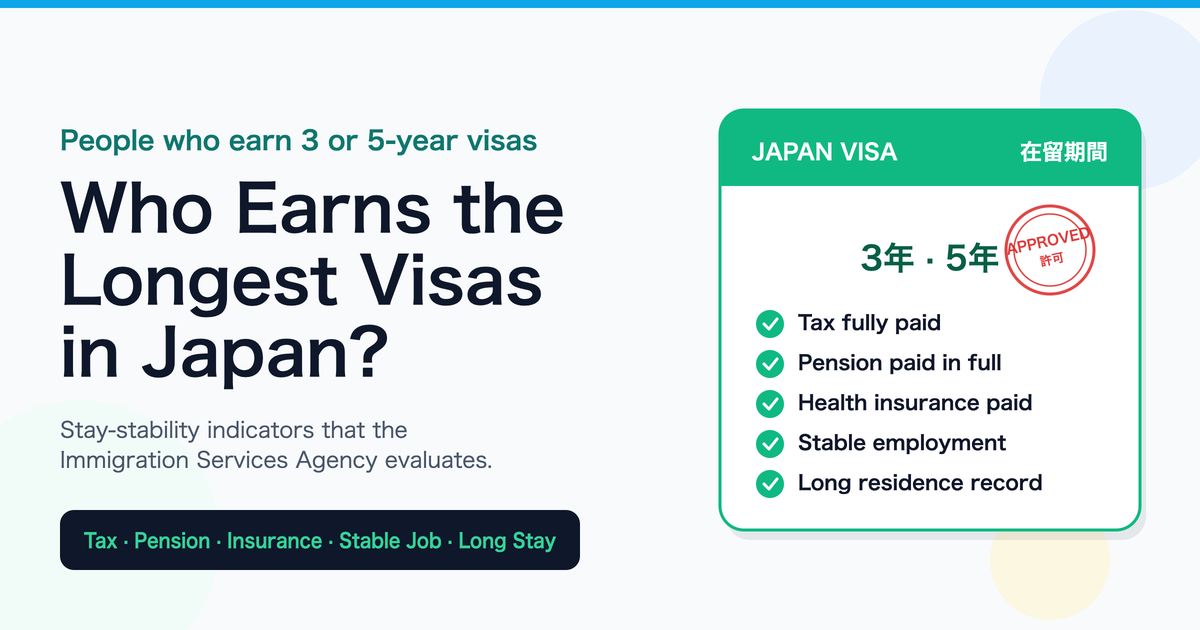
Common traits include:
- All taxes paid in full
- All pension contributions paid in full
- All health insurance payments up to date
- Stable employment
- Long residence history in Japan
In short, Permanent Residence screening and the period-of-stay review point in the same direction. You can find out more about the specific benefits of obtaining Permanent Residence at Benefits of Obtaining Permanent Residence.
Frequently Asked Questions
Does receiving a 1-year visa mean there is a problem?
No. Receiving 1 year is very common on a first visa or first renewal.
Does a high salary automatically mean I’ll get 5 years?
No. Salary matters, but the review looks at a combination of factors including taxes, pension, and residence history.
If I receive a 3-year visa, can I apply for Permanent Residence?
It depends on your Status of Residence, but holding a 3-year period of stay often means you satisfy one of the requirements for a Permanent Residence application.
Conclusion
There is no secret formula for receiving a longer period of stay in Japan.
Ultimately, the Japanese government is asking one question:
“Is this person someone who can continue to live as a stable member of Japanese society going forward?”
If you pay your taxes, pension contributions, and health insurance faithfully and maintain stable employment, your chances of receiving a 3-year or 5-year period of stay will naturally increase over time.
If your goal is to obtain Permanent Residence, it is especially important to make a habit of consistently managing not only your period of stay, but also your tax and pension records.
Recommended Reading
- Key Factors Japan Looks at When Screening Your Visa — A comprehensive look at the factors immigration evaluates throughout the visa screening process
- Why Income Matters in Japanese Visa Screening — How income stability influences visa approval and period-of-stay decisions
- Why Work Experience Matters for Your Japan Visa Application — How long-term employment at a single company and career history are weighed in screening
Need to apply for or change your status of residence in Japan?
Easily create your Japanese status of residence application.