Why Work Experience Matters for Your Japan Visa Application
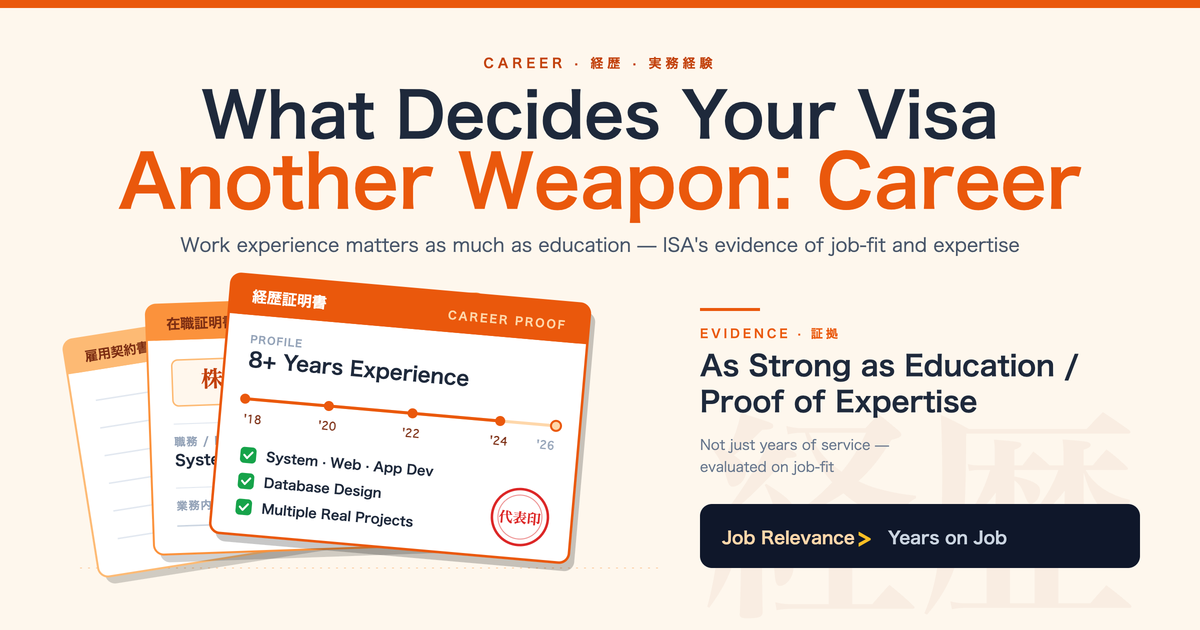
When preparing to work in Japan, many people focus solely on their educational background.
But there is another factor that carries just as much weight in the actual visa screening process.
That factor is work experience (practical career history).
For professionals in fields such as IT engineering, software development, design, marketing, and business planning, career experience can in fact be the decisive element in a visa application.
In this article, we explore why work experience matters so much when applying for a Japan visa, and what kinds of experience are recognized.
Japan Work Visas Are Designed to Verify Expertise
The most common Japan work visa status — Engineer / Specialist in Humanities / International Services (技術・人文知識・国際業務) — is a category designed for foreign nationals who possess specialized knowledge and technical skills.
In other words, the Japanese government is not simply checking whether someone wants to work in Japan. The key question is:
“Does this person have the ability and expertise to perform the specified role?”
The two primary ways to demonstrate that expertise are:
- Education
- Work experience
Why Work Experience Matters
The Immigration Services Agency (ISA) wants to confirm that an applicant is genuinely capable of performing the role they are being hired for.
Roles such as:
- Software developer
- Designer
- Marketer
- Accountant
- Trade specialist
all require a certain level of professional expertise.
If an applicant has hands-on experience in that field, it becomes
“This person has the ability to do the job”
— compelling evidence in their favor.
That is why career history is evaluated so seriously in visa screening.
Sometimes Experience Outweighs Education
Many people assume:
“As long as I have a university degree, the visa will be approved.”
But the actual screening process is not that straightforward.
For example, someone who has:
- 8 years of development experience
- A track record of real-world projects
will generally demonstrate job capability more convincingly than someone who has:
- A computer science degree
- No development experience
Especially in experienced-hire recruitment, work experience is frequently weighted more heavily than academic credentials. Why Education Matters When Applying for a Japanese Visa covers how academic background factors into visa screening in detail.
Experience Becomes Critical When Your Major Doesn’t Match the Job
There is one situation in particular where the value of work experience peaks.
That is when your academic major does not align with the job role you are applying for.
Examples include:
- Japanese language major → IT sales
- Economics major → Marketing
- History major → Business planning
In these cases, the direct connection between field of study and job duties may be weak.
However, if the applicant has relevant work experience, that gap can be bridged.
ISA assessors do in fact place significant weight on this kind of compensating career history.
Experience Can Substitute for Insufficient Education
Under certain conditions, Japan’s visa framework allows work experience to be recognized in place of formal educational credentials.
The most common example is the IT field.
There are documented cases of visa approval even where:
- No university degree was held
- Substantial relevant practical experience existed
This does not apply to every occupation, but the more specialized the role, the more weight career experience tends to carry.
What Kinds of Experience Are Recognized?
ISA does not simply look at how long someone has been employed.
What matters is what work was actually performed.
For a developer, relevant experience includes:
- System development
- Web development
- App development
- Database design
For a marketing role, practical experience in areas such as:
- Ad campaign management
- Market research
- Brand planning
- Digital marketing
is all considered useful evidence.
Why Career Documentation Is Required
When applying for a visa, applicants can submit a variety of documents to substantiate their work history.
Common examples include:
- Certificate of Employment
- Career Certificate
- Employment Contract
- Pay Slips
ISA uses these materials to verify:
“Did this person actually perform the stated work?”
For this reason, career documents should be prepared as specifically and concretely as possible.
The IT Field Places Especially High Value on Experience
Japan faces a significant labor shortage in the IT sector.
As a result, roles such as:
- Programmer
- Systems engineer
- Infrastructure engineer
- Data engineer
are areas where career experience is evaluated with particular care.
In practice, many Japanese companies place more emphasis on development track record and project history than on academic qualifications.
Experience Also Matters When Changing Jobs
Even if you already hold a Japan work visa, your career history remains important.
When you change employers, ISA may review:
- The nature of the new role
- The connection between your new duties and your prior experience
If the job function changes significantly, the continuity of your career path can become a key criterion in the assessment.
Why ISA Looks at Career History
The Immigration Services Agency (ISA) does not merely count years of employment.
What they are trying to establish through your career history is:
- Capacity to perform the work
- Level of specialization
- Fit between the person and the role
Ultimately, the core question is:
“Is this person qualified to perform this work in Japan?”
That is why career history serves as critical evidence in visa screening decisions.
Does More Experience Always Help?
Not necessarily.
For example, the assessment may be less favorable when:
- The experience is extensive but unrelated to the role
- The actual work performed is unclear
- Supporting documentation is difficult to provide
What matters is not simply the number of years worked, but the relevance of the experience to the target role. Key Factors Japan Looks at When Screening Your Visa summarizes the other factors ISA weighs comprehensively beyond career history.
Frequently Asked Questions
How many years of experience are required for a Japan work visa?
It depends on the occupation and individual circumstances.
That said, more experience generally makes it easier to demonstrate the required expertise.
Can I get a visa based on work experience if I did not graduate from university?
In some occupations, yes.
The IT field in particular is one area where practical experience is frequently recognized as a strong qualification.
Does part-time work experience count?
It depends on the nature of the work, but regular full-time employment is generally evaluated more favorably.
Is a Career Certificate always required?
It may be requested depending on the situation, and it serves as important evidence for substantiating your professional background.
Closing
In a Japan visa screening, your work history is far more than a single line on a resume.
Career experience is one of the most powerful forms of evidence for demonstrating an applicant’s expertise and ability to do the job.
This is especially true when your academic major does not match the role, or when your formal education credentials are limited — in those cases, career history can become the deciding factor.
If you are preparing to work in Japan, it is not enough to simply list your employment dates. Take the time to organize:
- What work you actually performed
- What results you achieved
- What expertise you have developed
Japan’s work visa system ultimately asks: “Is this person capable of performing specialized work in Japan?” — and career experience is one of the most important tools you have to answer that question.
Recommended Reading
- Why Income Matters in Japanese Visa Screening — The weight of income stability evaluated alongside education and career
- How Japanese Language Ability Affects Your Visa Application — The extent to which Japanese proficiency such as JLPT is assessed in screening
- What Happens if You Have a Criminal Record When Applying for a Japan Visa? — How a criminal or regulatory violation history affects visa screening
Need to apply for or change your status of residence in Japan?
Easily create your Japanese status of residence application.