Japan Residence Period: 1-Year, 3-Year, and 5-Year Differences
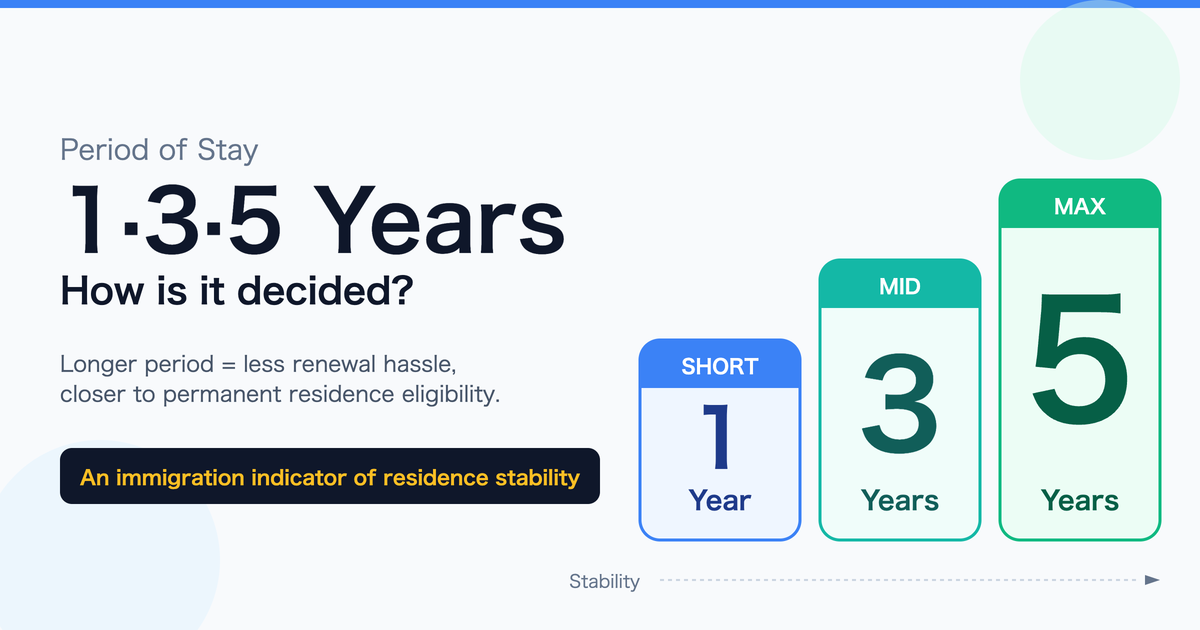
When you obtain a long-term Status of Residence in Japan — such as a work visa, spouse visa, or business manager visa — your Residence Card will display your Period of Stay (在留期間).
Even among people working at the same company with the same visa type, some may receive 1 year, others 3 years, and still others 5 years. This is why questions like “Why did I only get 1 year?” and “What do I need to do to get 3 or 5 years?” come up so often.
In this article, we’ll explore the differences between 1-year, 3-year, and 5-year periods of stay in Japan and the criteria used to determine them.
What Is the Period of Stay?
The Period of Stay refers to the length of time a foreign national is authorized to remain in Japan.
For example, even within the same status — such as Engineer / Specialist in Humanities / International Services (技術・人文知識・国際業務) — the period of stay can vary as follows:
- 1 year
- 3 years
- 5 years
In other words, think of it this way:
- Status of Residence = what activities you are permitted to do in Japan
- Period of Stay = how long you are permitted to remain in Japan
Many people confuse the two, but they are entirely separate concepts. If you’d like to learn more about Status of Residence itself, see our guide on Understanding Status of Residence.
Why a Longer Period of Stay Is Better
A longer period of stay comes with several advantages.
Fewer visa renewals required
A 1-year visa must be renewed every year. With a 3-year or 5-year visa, you won’t need to go through the renewal process during that period.
This means fewer trips to the immigration office and less paperwork to prepare.
Stronger position for Permanent Residence applications
In the review process for Japanese Permanent Residence, the period of stay you currently hold is generally given significant weight.
In particular, holding a period of stay of 3 years or more often helps satisfy one of the requirements for a Permanent Residence application.
Potential advantage in financial assessments
When applying for a mortgage or car loan, a longer period of stay may be viewed more favorably as a sign of stability.
If you are considering purchasing property in Japan, a 3-year or 5-year period of stay can work in your favor.
When You Receive a 1-Year Period of Stay
Receiving 1 year is common when you first enter Japan or first obtain a Status of Residence.
Typical situations include:
- Your first year of employment in Japan
- Your first visa application
- Shortly after changing jobs
- Working for a small company
- Relatively low income level
- Short residence history in Japan
A 1-year period does not necessarily mean there is a problem. The Immigration Services Agency of Japan often grants 1 year first in order to observe the applicant’s situation over time. There is no need to worry if you receive 1 year on your first application.
When You Receive a 3-Year Period of Stay
Generally, once the Immigration Services Agency determines that you are living stably in Japan, the likelihood of receiving a 3-year period of stay increases.
Typical situations include:
- Long-term employment at the same company
- Consistent income
- No outstanding residence tax (住民税)
- No outstanding pension contributions
- No outstanding health insurance payments
- No past visa issues
In practice, many foreign nationals move up to 3 years at their first or second renewal.
When You Receive a 5-Year Period of Stay
Five years is the longest standard period of stay available. It is granted when the Immigration Services Agency rates the applicant’s residential stability very highly.
Typical characteristics include:
- Long-term residence in Japan
- Stable employment
- High income
- All taxes, pension, and insurance payments fully up to date
- No history of legal violations
However, not everyone will receive 5 years, and many people transition to 5 years after receiving 3 years multiple times.
Who Decides the Period of Stay?
The period of stay is determined through a comprehensive assessment by an examiner at the Immigration Services Agency of Japan.
Writing that you hope to receive 5 years on your application does not guarantee that you will receive it.
Factors considered in the review include:
- Job stability
- Company size
- Length of employment
- Annual salary
- Tax payment status
- Pension contribution status
- Health insurance payment status
- Residence history in Japan
- Past immigration records
All of these factors are reviewed together to determine the final period of stay. These items are also evaluated as important factors in visa application screening itself. For a comprehensive overview, see Key Factors Japan Looks at When Screening Your Visa.
Why Do I Keep Getting Only 1 Year?
Some people continue to receive only 1-year renewals even after living in Japan for a long time.
Common reasons include:
Outstanding residence tax
Unpaid residence tax (住民税) is viewed very negatively in immigration reviews.
Unpaid pension contributions
In recent years, pension payment status has been checked not only for Permanent Residence applications but also during regular visa renewal reviews.
Frequent job changes
Changing jobs frequently in a short period may lead to a determination that your situation lacks stability.
Company circumstances
Even if there are no issues on your end, the size or financial condition of your employer can affect the outcome.
How to Increase Your Period of Stay
To work toward a longer period of stay, it is important to consistently manage the following:
- Pay residence tax on time
- Make diligent payments toward the National Pension (国民年金) or Employees’ Pension (厚生年金)
- Keep health insurance payments up to date
- Maintain stable employment
- Avoid frequent job changes
- Conduct activities within the scope of your Status of Residence
There is no secret trick — demonstrating that you are living stably in Japan is the single most important factor.
Frequently Asked Questions
Does receiving a 1-year visa mean something is wrong?
No. Receiving 1 year is perfectly normal when you are getting your visa for the first time or have a short residence history in Japan.
If I receive a 3-year visa, can I apply for Permanent Residence?
It depends on your Status of Residence, but holding a 3-year period of stay often means you satisfy one of the requirements for a Permanent Residence application.
Does a 5-year visa mean I have Permanent Residence?
No. A 5-year period of stay is not Permanent Residence — it simply means you have a Status of Residence with a longer renewal cycle.
Conclusion
The 1-year, 3-year, and 5-year periods of stay in Japan are more than just durations — they reflect how the Immigration Services Agency of Japan evaluates the stability of your residence.
Receiving 1 year does not mean there is a problem. If you pay your taxes and pension contributions faithfully and maintain a stable life, your chances of receiving a 3-year or 5-year period of stay in the future will increase.
If your goal is Permanent Residence in Japan, it is especially important to carefully manage not only your period of stay but also your records for taxes, pension, and health insurance. You can learn more about the specific benefits of Permanent Residence at Benefits of Obtaining Permanent Residence.
Recommended Reading
- Who Gets a Longer Period of Stay in Japan? Key Traits That Matter — Common traits shared by those who receive 3- or 5-year residence periods
- Why Income Matters in Japanese Visa Screening — How income influences visa and residence period decisions
- Why Work Experience Matters for Your Japan Visa Application — The weight of stable employment and career history in screening
Need to apply for or change your status of residence in Japan?
Easily create your Japanese status of residence application.