Complete Guide to the COE (Certificate of Eligibility) Issuance Process
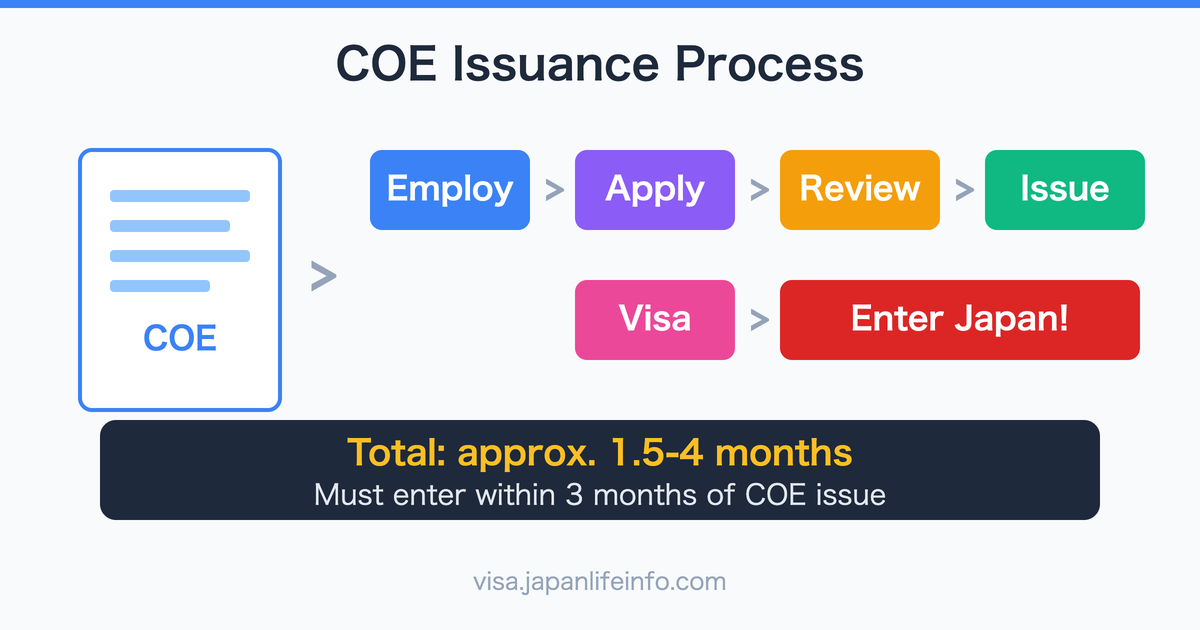
Getting a job offer from a Japanese company does not mean you can enter Japan right away. First, you need to obtain a COE (Certificate of Eligibility).
The COE is a pre-entry screening process that verifies your eligibility to work in Japan. You need this document to apply for a work visa at the Japanese embassy.
What is a COE?
COE stands for Certificate of Eligibility (在留資格認定証明書) in Japanese.
It is issued by the Immigration Services Agency of Japan (出入国在留管理庁).
This certificate verifies:
- Whether the applicant’s educational background and work experience are suitable for the status of residence
- The stability and legality of the employing company
- The relevance of job duties to the status of residence
- Whether the salary level is equal to or higher than that of Japanese workers
In other words, it is a pre-screening process to determine “Is there any problem with this person performing the relevant activities in Japan?”
When COE Is and Is Not Required
| Category | COE Required? |
|---|---|
| First-time entry to Japan from overseas (employment, study, etc.) | Required |
| Change of status of residence within Japan (e.g., student to work) | Not required |
| Extension of period of stay | Not required |
| Short-term stay (sightseeing within 90 days, etc.) | Not required |
| Re-entry after departure with re-entry permission | Not required |
COE is mainly required when entering Japan for the first time from overseas. If you are already residing in Japan and wish to change your status of residence, you apply for a “Change of Status of Residence” instead of a COE. For detailed procedures, see Status of Residence Application Process Guide.
Step-by-Step COE Issuance Process
Step 1: Sign Employment Contract with Japanese Company
First, sign a formal employment contract with the Japanese company. Typically, COE preparation begins after receiving the job offer letter.
Things to verify at this stage:
- Whether the employment contract clearly states the job duties, salary, workplace, and contract period
- Whether the job duties match the status of residence you are applying for
- Whether the salary is equal to or higher than that of Japanese workers performing the same duties
Step 2: Company Applies to the Immigration Bureau in Japan
The COE application is usually handled by the company. This is because the applicant is overseas.
The application is submitted to the regional Immigration Services Agency office with jurisdiction over the company’s location. For jurisdiction information, see Immigration Bureau Application Locations by Residence.
Required Documents
Applicant’s documents:
- Certificate of Eligibility application form (downloadable from the Immigration Services Agency website)
- ID photo (4cm height x 3cm width, taken within the last 3 months). For detailed specifications, see ID Photo Requirements Guide
- Return envelope (with 404 yen worth of stamps attached)
- Graduation certificate or degree certificate (original or notarized copy)
- Resume (including educational and work history)
- Japanese Language Proficiency Test certificate (if applicable)
Company’s documents:
- Copy of employment contract
- Company registration certificate (issued within the last 3 months)
- Job description (with detailed description of job duties)
- Financial statements (for the most recent fiscal year)
- Materials explaining the company’s business activities (company brochure, business report, etc.)
Differences based on sponsoring organization category:
The Immigration Services Agency classifies sponsoring organizations into 4 categories, and required documents vary by category.
| Category | Applicable Organizations | Required Documents |
|---|---|---|
| Category 1 | Listed companies, government agencies, independent administrative agencies, etc. | Minimal documents (copy of quarterly report, etc.) |
| Category 2 | Organizations with withholding tax of 10 million yen or more in the previous year | Simplified documents |
| Category 3 | Organizations with withholding tax of less than 10 million yen in the previous year | Detailed documents (financial statements, business description, etc.) |
| Category 4 | Others (including newly established companies) | Most detailed documents (business plan, etc. in addition) |
Large companies in Categories 1 and 2 require fewer documents and reviews are relatively faster. In contrast, small and medium-sized companies in Categories 3 and 4 require more documents.
Online Application
Since March 2023, COE applications can also be submitted online. Employees of the sponsoring organization, lawyers, and administrative scriveners can use the “Residence Application Online System” to apply.
Step 3: Review (Takes 1-3 Months)
The average review period is 1 to 3 months.
The timeline varies based on the following factors:
- April hiring season: Applications are concentrated from January to March, which tends to extend review periods
- Company size and category: Category 1 and 2 companies are processed relatively quickly
- Job specialization: Applications are more favorable when job duties are clear and highly relevant to the applicant’s major
- Relevance of major to job duties: If the university major has low relevance to job duties, additional review may be needed
- Whether additional documents are requested: Requests for additional materials cause further delays
Step 4: COE Issuance
Once the review is approved, the COE is issued. The company forwards it to the applicant (by mail or electronic COE).
About Electronic COE (電子的COE):
- Electronic COE was introduced in March 2023
- You can receive the COE via email instead of postal mail
- The electronic COE can be displayed on a smartphone for visa applications and immigration inspection
- Eliminates the waiting period for postal delivery, speeding up the overall process
COE validity period: 3 months from the date of issuance. You must enter Japan within this period.
Step 5: Apply for Visa at Japanese Embassy in Your Home Country
After receiving the COE, apply for a work visa at the Japanese embassy or consulate in your home country.
For example, if you are in Korea, you apply for the visa at the Embassy of Japan in Korea or the consulate with jurisdiction over your area.
Documents required for visa application:
- Visa application form
- Passport
- ID photo
- COE original or electronic COE
- Other documents required by the embassy
Note: The embassy or consulate where you can apply for a work visa depends on your home address, so be sure to check in advance!
Visa issuance typically takes 3 to 7 days.
Step 6: Enter Japan and Receive Residence Card
After passing immigration inspection at a Japanese airport, you receive your residence card.
Airports that issue residence cards:
- Narita Airport
- Haneda Airport
- Kansai Airport
- Chubu Airport
- New Chitose Airport
- Fukuoka Airport
- Hiroshima Airport
If you enter through a different airport, your residence card will be sent by mail when you register your address at your local municipal office.
This step must be completed before you can officially start working.
Most Common Issues in COE Applications
Here are the main reasons COE applications are denied. Review these in advance to prepare.
| Reason for Denial | Explanation | How to Address |
|---|---|---|
| Mismatch between major and job duties | The relevance between the university major and job duties is not recognized | Specifically describe the relevance of the major to the job in the job description |
| Insufficient company financial status | Concerns about business stability for companies with losses or newly established companies | Submit supplementary materials such as business plans and future revenue projections |
| Salary below standards | Salary lower than the average for Japanese workers in the same occupation | Review the salary level or provide a reasonable explanation |
| Vague job description | Job duties that may be deemed simple labor | Describe job duties specifically to highlight the required expertise |
| Missing documents | Required documents not submitted or incomplete | Verify with a checklist before submission |
Screening tends to be more thorough for small and medium-sized companies (Categories 3 and 4). For detailed denial reasons, see Visa Rejection Reasons and How to Address Them.
What to Do If Your COE Is Denied
If your COE is denied, the following actions are possible:
- Confirm the reason for denial: You can inquire about the reason with the Immigration Services Agency
- Reapply after addressing the issues: You can reapply after resolving the reason for denial. There is no limit on the number of reapplications
- Consult an administrative scrivener: Getting professional help to improve your documents is also an option
- Consider a different status of residence: If the current status of residence is difficult, explore the possibility of a different one
Total Timeline Summary
| Stage | Average Duration |
|---|---|
| Document preparation | 1-2 weeks |
| COE review | 1-3 months |
| COE postal delivery | 1-2 weeks (instant for electronic COE) |
| Visa issuance | About 1 week |
| Total | About 2-4.5 months |
Therefore, it is safest to start preparation at least 3-4 months before your intended start date. If you are targeting an April start, it is best to begin the application in early December.
In Closing
Working in Japan does not end with receiving a job offer. You need the COE before you can enter Japan.
Many people think “job offer = done,” but in reality, COE screening is the most critical gateway.
By preparing your documents thoroughly and allowing sufficient time, you can smoothly obtain your COE.
Reference Links
Need to apply for or change your status of residence in Japan?
Easily create your Japanese status of residence application.