How to Receive Your Residence Card Upon Arriving in Japan
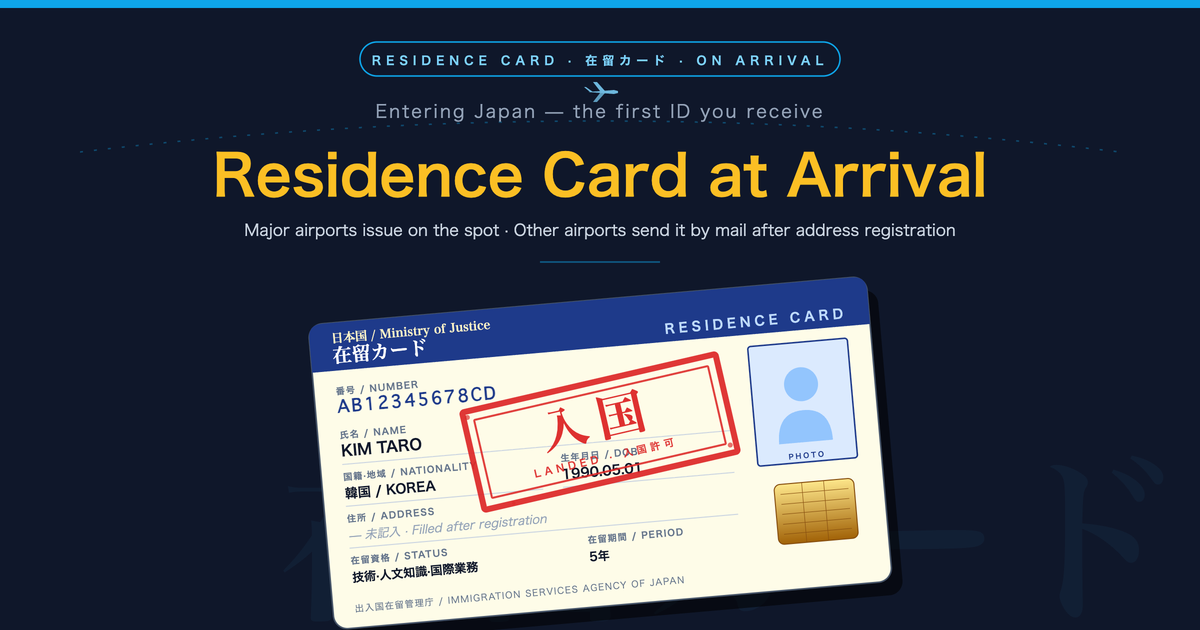
If you are entering Japan for the first time on a work visa, student visa, dependent visa, or spouse visa, there is one thing you absolutely need to know.
That is the residence card (在留カード).
The residence card serves as the official ID for foreign nationals staying in Japan for a medium to long term — and it is an extremely important document.
It is no exaggeration to say that it is the starting point for virtually every aspect of life in Japan: opening a bank account, getting a mobile phone plan, signing a lease, and completing various administrative procedures.
In this article, we will walk you through how to receive your residence card upon entering Japan and what steps to take afterward.
What Is a Residence Card?
A residence card is an ID document issued to foreign nationals who stay in Japan for more than three months.
The card contains the following information:
- Full name
- Nationality
- Date of birth
- Status of residence
- Period of stay
- Residence card number
- Whether employment is restricted
In Japan, you are legally required to carry your residence card at all times.
Basic Requirements to Receive a Residence Card
Before entering Japan, you must complete the following steps:
- Obtain a Certificate of Eligibility (COE)
- Apply for a visa at a Japanese embassy or consulate
- Enter Japan using that visa
Once you complete this process and enter Japan, you will be issued a residence card. The entire COE application and issuance process is covered in Complete Guide to the COE (Certificate of Eligibility) Issuance Process.
Receiving Your Residence Card at Immigration Inspection
At certain major international airports, you can receive your residence card on the spot during immigration inspection.
The airports where this is available include:
- Narita Airport
- Haneda Airport
- Kansai International Airport
- Chubu Centrair International Airport
- New Chitose Airport
- Hiroshima Airport
- Fukuoka Airport
If you enter through one of these airports, your residence card will be issued right there after immigration inspection.
The Process of Receiving Your Residence Card at the Airport
The general procedure is as follows:
1. Immigration Inspection
Present your passport and visa.
If necessary, the officer may also review documents related to your COE.
2. Landing Permission
Once the immigration inspection is complete, you will be granted landing permission.
3. Residence Card Issuance
If you are confirmed as a long-term resident, your residence card will be issued on the spot.
The card will show information such as:
- Status of residence
- Period of stay
Cases Where You Cannot Receive Your Card at the Airport
Not all airports issue residence cards immediately.
If you enter through an airport or seaport other than the major airports listed above, the process is slightly different.
At immigration inspection, your passport will be stamped with a note indicating:
Residence card to be issued at a later date
Receiving Your Card by Mail
If you do not receive your residence card at the airport, it will be mailed to you after you complete address registration in Japan.
The procedure is as follows:
1. Secure a Place of Residence in Japan
First, determine the address where you will actually be living.
2. Complete Moving-In Notification at Your City or Ward Office
Go to the city or ward office that covers your area and complete your resident registration (moving-in notification).
You are generally required to do this within 14 days of moving in.
3. Receive Your Residence Card by Mail
Once your address has been registered, your residence card will be mailed to the registered address.
The First Things to Do After Arriving in Japan
Receiving your residence card does not mean all the procedures are finished.
After entering Japan, you will need to take care of the following:
- Address registration: Register your address at your city or ward office
- National Health Insurance enrollment: If applicable, enroll in the plan
- National Pension registration: Register if you are required to
- Bank account opening: A residence card is required
- Mobile phone plan setup: Most carriers require you to present your residence card
Your residence card serves as the primary form of ID for daily life in Japan.
You Must Carry Your Residence Card at All Times
This is something many people overlook.
In Japan, foreign nationals on a medium to long-term stay are legally required to carry their residence card at all times.
Failing to present it when requested by police or other authorities can cause problems.
Once you start living in Japan, you will find yourself using your residence card far more often than your passport.
The Address Section May Be Blank
When you first receive your residence card at the airport, the address field is often left blank.
This is because your address in Japan has not yet been registered.
Once you complete your moving-in notification, the city or ward office will write your address on the back of the card.
What If You Move After Arriving?
If you move to a new address, you are also required to report the change of address.
After the change is submitted, your new address will be recorded on your residence card.
Japan takes the management of foreign residents’ addresses seriously, so be sure to report any move without delay. For a full overview of all notification obligations you need to stay on top of while living in Japan, see Complete Guide to Notification Obligations for Foreigners in Japan.
What to Do If You Lose Your Residence Card?
If your card is lost or stolen, you must:
- Report it to the police
- Apply for a replacement at the Immigration Services Agency of Japan
Since the residence card is a critical document that proves your right to stay in Japan, you should take immediate action if it is ever lost.
Frequently Asked Questions
Will I always receive my residence card at the airport when entering Japan?
No.
On-the-spot issuance is only available at select major airports. At other airports, the card will be mailed to you after you register your address.
Can I get by in Japan without a residence card?
Practically speaking, it is very difficult.
It is essentially required for banking, mobile phone contracts, and most administrative procedures.
Will my address be printed on the residence card when I receive it?
In most cases, the address field will be blank when the card is first issued.
Your address will be added after you complete your moving-in notification.
Do I really have to carry my residence card at all times?
Yes.
In Japan, you are legally required to carry it with you at all times.
Wrapping Up
The residence card is the most important form of ID for foreign nationals on a long-term stay in Japan.
If you enter Japan on a work visa, student visa, or spouse visa, you will almost certainly be issued a residence card.
At major airports like Narita, Haneda, and Kansai International, you can receive it immediately during immigration inspection. At some other airports, it will be sent to you by mail after you register your address.
Once you start living in Japan, you will use your residence card for nearly everything — from opening a bank account to signing a mobile phone contract — so it is important to stay on top of address registration and card management right from the start.
Recommended Reading
- What to Watch Out for at Japanese Immigration Inspection — Tips for passing immigration inspection, the step before your residence card is issued
- What Do Japanese Immigration Officers Check? — A summary of what immigration officers actually evaluate
- What Is Japan’s Immigration Services Agency? — The role and key functions of the agency that manages residence cards
Need to apply for or change your status of residence in Japan?
Easily create your Japanese status of residence application.