What Do Japanese Immigration Officers Check?
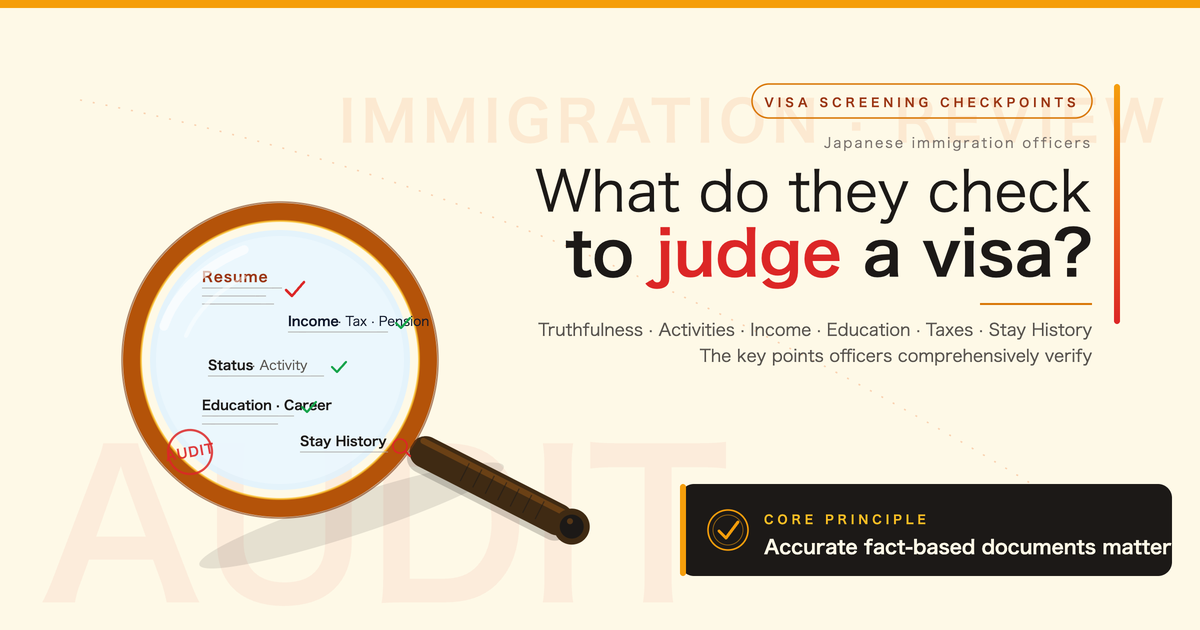
When applying for a Japanese work visa, spouse visa, business manager visa, or permanent residence, your application goes through a review by the Immigration Services Agency of Japan.
Many people wonder:
“What exactly do immigration officers look at?”
“Does salary matter?”
“Does Japanese language ability matter?”
“Do they check taxes and social insurance too?”
The full screening criteria are not publicly disclosed, but it is fairly well known which areas the Immigration Services Agency of Japan considers most important.
This article summarizes the key checkpoints that Japanese immigration officers typically examine during the visa screening process.
1. Truthfulness of the Application — the First Priority
The single most important factor in immigration screening is whether the information you submitted is accurate.
No matter how strong your qualifications, any false statement can significantly affect the outcome.
Common examples that are treated very seriously include:
- Fabricated work experience
- Forged academic degrees
- Fake employment certificates
- Sham marriages
- False business plans
Immigration officers also carefully check the consistency among all submitted documents.
2. Whether the Status of Residence Matches the Actual Activity
A Japanese visa is not simply permission to stay in Japan — it is granted for a specific purpose.
For example:
- Work visa → performing work duties at a company
- Student visa → attending school
- Spouse visa → living as a family
- Business manager visa → operating a business
Officers therefore verify that the stated purpose of the application aligns with what the applicant will actually be doing.
3. Whether Stable Living in Japan Is Feasible
Immigration also places significant weight on whether the applicant can support themselves stably in Japan.
Items typically examined include:
- Salary level
- Income
- Assets
- Whether living expenses are covered
In particular, when sponsoring family members or applying for long-term residence, a solid financial foundation is weighted even more heavily.
4. Educational Background and Work History
For work visas, educational background and work history are critical factors.
Especially for Engineer / Specialist in Humanities / International Services visas, officers review:
- Whether the applicant holds a university degree
- The relevance of the major to the job
- Professional work experience
For example, if applying for an IT engineer visa:
- A computer-related major
- Experience in the IT field
can both work in the applicant’s favor.
5. Credibility of the Employer
For work visa applications, the employer is also subject to scrutiny, not just the applicant.
Immigration can verify the company’s:
- Business substance
- Revenue
- Number of employees
- Financial condition
There are cases where additional documents are requested when a company’s situation appears unstable.
6. Tax and Social Insurance Payment Status
This is an area that has grown increasingly important in recent Japanese visa screening.
Particularly in:
- Permanent residence applications
- Spouse visa renewals
- Long-term residence-related reviews
officers frequently check tax and social insurance payment records in detail.
Items commonly reviewed include:
- Resident tax
- Income tax
- Health insurance premiums
- National pension contributions
Late payments or unpaid amounts can work against you in the screening process.
7. Japan Residence History
Immigration reviews past records of time spent in Japan.
This includes:
- Previous visa history
- Entry and exit records
- Whether there has been any overstay
- Whether any status of residence violations occurred
A history of illegal stay or unauthorized employment can have a significant impact on screening. For information on how to check your own entry and exit records, see How to Check Your Entry/Exit Records in Japan.
8. Criminal Record
A criminal history, whether in Japan or abroad, can affect the outcome.
Offenses that are evaluated particularly strictly include:
- Serious crimes
- Drug-related offenses
- Fraud
- Violent crimes
The outcome may vary depending on the type of offense, when it occurred, and the resulting penalty. For details on how a criminal record affects visa screening and how outcomes differ by case, see What Happens if You Have a Criminal Record When Applying for a Japan Visa?.
9. Japanese Language Ability
Japanese language ability is not legally required for most visa types.
However, it can have an indirect influence in some situations, such as:
- Working at a Japanese company
- Operating a business under the business manager visa
- Adapting to daily life in Japan
In some recent visa categories and permanent residence frameworks, Japanese language proficiency is used as a bonus factor.
10. Authenticity of the Family Relationship
This is especially important for spouse visa screenings.
Immigration verifies:
- Whether the couple is in a genuine marital relationship
- Whether they are living together
- Whether the circumstances of the marriage appear natural
Sham marriages are one of the areas subject to particularly strict enforcement.
11. Whether the Purpose of Stay in Japan Is Clear
Immigration checks why the applicant intends to reside in Japan.
The purpose must be clear, such as:
- Employment
- Study
- Running a business
- Living with family
A vague or contradictory explanation of purpose can affect the screening outcome.
12. Consistency Across Submitted Documents
Immigration officers do not look at any single document in isolation.
They compare the entire set of submitted materials.
For example, they check for any inconsistencies among:
- Resume
- Certificate of employment history
- Tax documents
- Company-related paperwork
Even minor discrepancies can trigger additional scrutiny, so attention to detail matters.
Why Do They Ask for Additional Documents?
You may receive a request for additional documents during the screening process.
Common examples include:
- Proof of income
- Tax payment certificate
- Certificate of employment
- Family relationship documents
A request for additional documents often simply means clarification is needed — it does not necessarily mean your application will be denied. For guidance on how to respond, see How to Respond to an Additional Document Request During Japan Visa Review.
Frequently Asked Questions
Does a high salary guarantee approval?
It is not an absolute criterion, but it can serve as evidence of financial stability.
Can unpaid taxes cause problems?
Yes, particularly in permanent residence screenings and long-term residence-related reviews, unpaid taxes can be a disadvantage.
Will my visa be denied if my Japanese isn’t good?
It depends on the visa type, but generally, Japanese language ability alone does not determine the outcome.
Does immigration screen the employer too?
Yes. For work visas, the employer’s situation is also an important factor in the review.
Conclusion
Japanese immigration officers do not simply check documents for form’s sake — they conduct a comprehensive review of the applicant’s purpose of stay, financial stability, and compliance with laws and regulations.
In recent years, there is a growing tendency to place greater emphasis on:
- Tax payments
- Social insurance enrollment
- Actual activities conducted
- Authenticity of submitted documents
The most important thing in the visa screening process is not any special trick, but rather submitting accurate, fact-based documents and demonstrating a stable history of life in Japan.
Paying taxes and insurance diligently and maintaining activities appropriate to your status of residence is, in the end, the best approach to managing your visa situation.
Recommended Reading
- Key Factors Japan Looks at When Screening Your Visa — A summary of the comprehensive factors immigration evaluates, including education, career, income, and taxes
- What Is Japan’s Immigration Services Agency? — The role and key responsibilities of the agency that handles screening
- What to Watch Out for at Japanese Immigration Inspection — Information you need to be ready to provide to officers at the immigration inspection stage
Need to apply for or change your status of residence in Japan?
Easily create your Japanese status of residence application.