Why Education Matters When Applying for a Japanese Visa
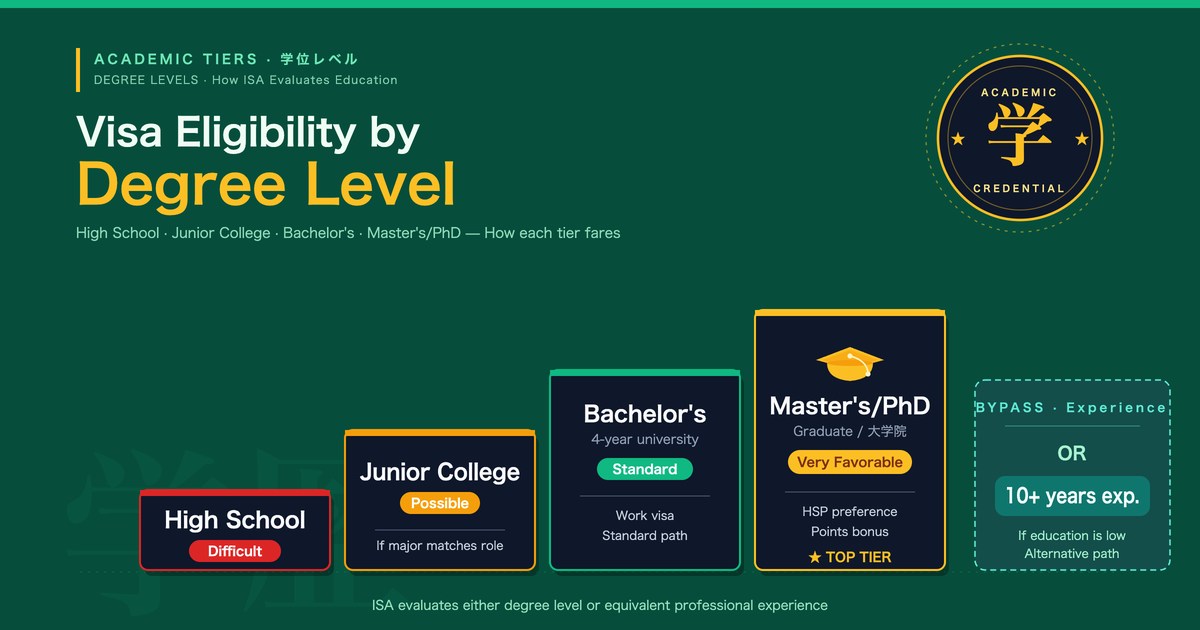
One of the most common questions from people preparing to work in Japan goes something like this.
“I didn’t graduate from university — can I still get a Japanese work visa?”
“Does it matter if my major doesn’t match the job?”
“How much does my educational background actually affect the visa assessment?”
The truth is, education is one of the most important factors in Japan’s work visa assessment process.
That said, it’s not simply about whether you attended a prestigious university or have an impressive academic pedigree.
In this article, we’ll look at why education matters when applying for a Japanese visa — and what you can do if your academic background falls short.
Why Education Matters for Japan Work Visas
The Engineer / Specialist in Humanities / International Services (技術・人文知識・国際業務) status of residence — Japan’s most common work visa category — was designed for foreign nationals who possess a certain level of professional expertise.
In other words, the Japanese government wants to confirm:
“Can this person actually perform work that requires specialized knowledge or technical skills?”
The most objective way to verify that is through educational background.
That’s why education becomes a critical benchmark during the work visa review process.
Japan Cares About the Degree Itself, Not the Prestige of the School
In some countries, the reputation of the institution matters enormously:
- Which university did you attend?
- Is it an elite school?
But what Japan’s Immigration Services Agency (ISA) focuses on is less about the school’s name and more about “Did you actually earn a degree?”
For example, a graduate from a top-tier university and a graduate from a regional university are largely treated the same if both hold a bachelor’s degree — at least when it comes to meeting the basic education requirement.
The ISA tends to verify the degree itself rather than the prestige of the institution.
Four-Year University Graduates Have the Strongest Case
Among foreign nationals who have obtained a Japanese work visa, graduates of four-year universities represent the most common profile.
Typical examples include:
- Computer science major → software developer
- Business administration major → marketing
- Japanese language major → translation/interpretation
- Design major → designer
When there’s a clear connection between your major and the role you’re applying for, the assessment tends to go relatively smoothly.
Can Junior College Graduates Apply?
Yes, they can.
However, the assessment criteria may vary depending on the country and the degree structure involved.
Graduates of two-year junior colleges or vocational programs can still obtain a work visa if there is a recognized connection between their field of study and the job duties.
This is especially true in fields such as:
- IT
- Design
- Trade
- Tourism
There are plenty of documented cases of junior college graduates successfully obtaining work visas in these areas.
What If My Major Doesn’t Match the Job?
It’s not automatically disqualifying.
For instance, the following combinations are often accepted:
- Business administration major → IT sales
- Japanese language major → overseas marketing
- Economics major → business planning
That said, if the connection is less obvious, the sponsoring company may need to provide documentation explaining:
- The reason for hiring this applicant
- Why the role requires their background
- The applicant’s relevant experience
Can You Get a Work Visa with Only a High School Diploma?
This is something a lot of people wonder about.
The short answer: the chances are very low.
Japan’s work visa system generally requires at least one of the following:
- University graduation
- Completion of a specialized vocational program
- Substantial relevant work experience
With only a high school diploma, it’s difficult to demonstrate the level of expertise required, and the assessment becomes considerably more stringent.
Insufficient Education Can Be Offset by Work Experience
If your educational background doesn’t meet the standard threshold, all is not lost.
The ISA does recognize substantial professional work experience as a qualifying alternative.
Roles such as:
- Software developers
- Engineers
- Designers
- IT specialists
…may be eligible for a work visa based on experience alone, provided the track record is strong enough.
There are documented cases of applicants without a university degree successfully obtaining work visas by demonstrating years of relevant hands-on experience. How work experience is evaluated in visa screening is covered in detail in Why Work Experience Matters for Your Japan Visa Application.
The IT Sector Has a Strong Track Record for Experience-Based Approvals
The IT industry in particular tends to place more weight on practical experience than many other fields.
Roles like:
- Programmers
- Systems engineers
- Web developers
- Infrastructure engineers
…are frequently evaluated based on demonstrated skill rather than academic credentials alone, and many companies in this space hire accordingly.
As a result, having sufficient relevant experience meaningfully increases your chances of visa approval.
Why Does the ISA Check Educational Background at All?
The Immigration Services Agency isn’t just looking for a diploma to check a box.
Education is used to assess:
- Professional expertise
- Job suitability
- The legitimacy of the employment purpose
For example, if someone applies for a developer visa with no related education and no relevant experience, it raises a natural question:
“Can this person actually perform development work?”
That’s why a solid educational background serves as important evidence of credibility for the stated employment purpose.
Education Isn’t the Only Thing That Matters
Education is important, but it alone won’t get a visa approved.
The ISA also reviews:
- Job duties and responsibilities
- Company stability
- Salary level
- Work history
- Past residence history in Japan
- Tax payment record
In short, having a university degree doesn’t guarantee approval — and lacking one doesn’t automatically disqualify you. The full range of factors the ISA considers holistically in visa screening is summarized in Key Factors Japan Looks at When Screening Your Visa.
Frequently Asked Questions
Do I need a university degree to get a Japanese work visa?
Generally speaking, a university degree gives you the strongest foundation. However, in some cases, relevant work experience can serve as an alternative.
Can I work in a field that doesn’t match my major?
Yes. However, you need to be able to demonstrate a clear connection between your major or experience and the job duties.
Does the prestige of your school matter?
In most cases, the ISA cares more about whether you earned a degree and how relevant your major is than which school you attended.
Can someone in the IT industry get a work visa without a degree?
Yes — there are cases where applicants with sufficient relevant experience have been approved for a work visa.
Closing Thoughts
Education is a significant factor in Japan’s work visa assessment.
But what the ISA is really trying to determine isn’t your academic pedigree — it’s:
“Is this person genuinely capable of performing specialized, professional work?”
University graduates can use their education to demonstrate expertise. Those without a degree can build their case through hands-on work experience.
Ultimately, what matters most isn’t the diploma itself — it’s how clearly your education or experience connects to the specific role you’re applying for.
If you’re planning to work in Japan, take time to honestly assess your academic background and work history. Identifying in advance how you’ll demonstrate your professional qualifications will go a long way in the visa assessment process.
Recommended Reading
- Why Income Matters in Japanese Visa Screening — The weight of income stability evaluated alongside education and work experience
- How Japanese Language Ability Affects Your Visa Application — How language proficiency such as JLPT is assessed in visa screening
- What Happens if You Have a Criminal Record When Applying for a Japan Visa? — How a criminal or legal violation history affects your visa screening
Need to apply for or change your status of residence in Japan?
Easily create your Japanese status of residence application.