Japan Deportation Cases: What Leads to Forced Removal?
If you are planning a long-term stay in Japan or are already living there, there is one thing you must be especially careful about.
That is forced deportation (強制退去).
Forced deportation is a system by which the Japanese government orders a foreign national to leave Japan.
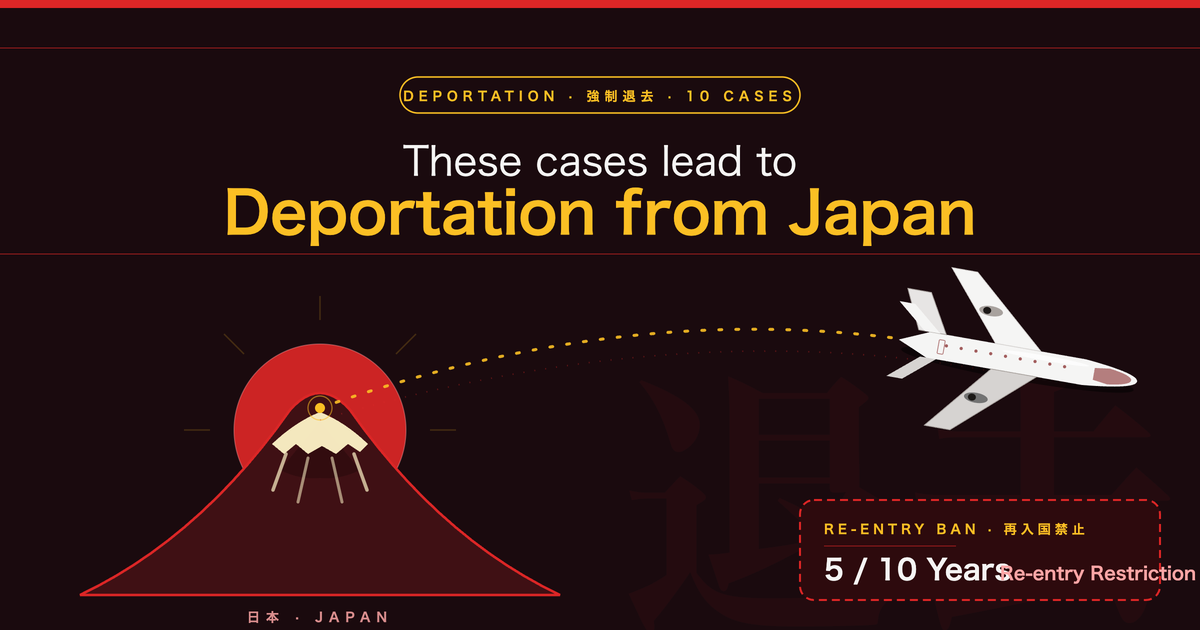
Once a deportation order is issued, re-entry into Japan may be restricted for a set period — and in some cases, you may be barred from returning for many years.
This article looks at representative real-world cases in which foreign nationals become subject to deportation.
What Is Forced Deportation?
Forced deportation is an administrative measure by which Japan’s Immigration Services Agency removes a foreign national from the country.
It is typically triggered by the following:
- Overstaying
- Illegal employment
- Criminal conduct
- False declarations
- Violation of residence status
Once a deportation order is finalized, you must leave Japan and will be subject to a re-entry ban for a certain period.
1. Continuing to Stay After Your Visa Expires
This is one of the most common deportation cases.
For example:
- Work visa expires
- Student visa expires
- Spouse visa expires
…and the person continues to stay in Japan without renewing.
This is called overstaying.
A single day over the limit does not automatically result in deportation, but if discovered it can become a serious problem.
2. Working on a Tourist Visa
This applies to people who enter Japan on a short-term stay (tourist) visa and then work while here.
Examples include:
- Part-time work at a restaurant
- Factory work
- Construction site work
- Delivery work
Because a tourist visa does not permit employment, being caught can make you subject to deportation.
3. Excessive Part-Time Work by Students
International students may work part-time up to a certain number of hours if they have permission for activities outside their status.
However, exceeding the allowed hours can cause problems.
Common violations include:
- Exceeding the weekly permitted hours
- Working without permission
- Working in the adult entertainment industry
If discovered, these may be deemed a violation of residence status.
4. Working Outside the Scope of Your Work Visa
Even if you hold a work visa, you cannot do just any kind of work.
For example:
- Holding an office/clerical visa but performing only manual labor
- Holding an engineer visa but doing completely unrelated work
These situations can become problems.
Immigration authorities can verify whether your actual duties match your residence status. You can check the scope of permitted activities for each status of residence at Permitted Activities by Status of Residence in Japan.
5. Obtaining a Visa Using Falsified Documents
This is treated as an extremely serious violation.
Examples include:
- Fabricated employment certificates
- False educational credentials
- Forged company registration documents
- Fraudulent business plans
…used to obtain a visa.
Even if the falsification is discovered after the visa has been issued, it can lead to cancellation of residence status and deportation.
6. Sham Marriage Discovered
This applies to cases where a person married without genuine intent to form a marital relationship, in order to obtain a spouse visa.
Common examples:
- Marrying in exchange for money
- Not actually living together
- No real marital relationship
Sham marriages are one of the areas Japan enforces most strictly.
If discovered, there is a risk of visa cancellation and deportation.
7. Committing a Serious Crime
Committing a criminal offense while residing in Japan can also make you subject to deportation.
Common examples include:
- Violent crimes
- Theft
- Fraud
- Drug offenses
- Sexual crimes
Depending on the nature of the crime and the severity of punishment, deportation proceedings may begin after release. The impact of a criminal record on visa and permanent residency screening is covered in detail at What Happens if You Have a Criminal Record When Applying for a Japan Visa?.
8. Drug-Related Offenses
Japan takes an extremely strict stance on drug offenses.
The following are among the cases with the highest likelihood of deportation:
- Possession of drugs
- Drug use
- Drug smuggling
- Drug trafficking
Drug-related criminal records are also evaluated very negatively at Japan’s immigration checkpoints.
9. Failure to Meet Residence Card Reporting Obligations
Long-term residents in Japan have certain reporting obligations.
Examples include:
- Reporting a change of address
- Reporting a change of affiliated organization
- Reporting a divorce from your spouse
A simple mistake will not immediately lead to deportation, but deliberate non-reporting or repeated violations can become a problem. All reporting obligations you need to meet during your stay are summarized at Complete Guide to Notification Obligations for Foreigners in Japan.
10. Staying for an Extended Period Without Employment Activity
Foreign nationals holding a work visa who resign and then remain without engaging in employment for a long time should also be careful.
If the following are confirmed:
- Prolonged unemployment after resignation
- No intention to seek work
- Actual activity has ceased
…it may become grounds for cancellation of residence status.
What Happens After Deportation?
Once a deportation order is finalized, you must leave Japan.
You will also be subject to a re-entry ban for a set period.
Typically:
- 5-year entry ban
- 10-year entry ban
…may be applied.
The duration can vary depending on the circumstances.
Voluntary Departure vs. Forced Deportation
There is also a system that allows people who are in an overstay situation to leave Japan on their own.
In general, if voluntary departure is recognized, the re-entry restriction may be less severe than for forced deportation.
Therefore, if a problem arises, it is important not to ignore it and to respond quickly.
How to Avoid Deportation
To live stably in Japan, you must observe the following:
- Check your visa renewal deadlines
- Only engage in activities within the scope of your residence status
- Pay taxes and insurance faithfully
- Comply with reporting obligations
- Do not engage in illegal employment
- Do not submit falsified documents
Most deportation cases arise from failure to follow basic regulations.
Frequently Asked Questions
Will I be deported if my visa expires just one day ago?
Deportation is not decided immediately, but you are technically in an overstay situation, so you must take action right away.
Can a student be penalized for exceeding part-time work hours?
Yes.
If the violation is repeated or intentional, it may be deemed a violation of residence status.
If I am deported, can I never return to Japan?
Once the re-entry ban period has passed you may reapply, but your previous deportation will affect the screening process.
Can permanent residents also be deported?
Yes.
If a permanent resident commits a serious crime or similar offense, they can also be subject to deportation.
Conclusion
Japan’s deportation system does not target only criminals.
Overstaying, illegal employment, false declarations, and violations of residence status can all be grounds for deportation.
In particular, Japan has been tightening its management of foreign residents in recent years, so it is important to have an accurate understanding of visa and residence status regulations.
Most foreign nationals who live by the rules will never face deportation.
However, please remember that managing your visa period, fulfilling reporting obligations, and conducting activities that match your residence status are fundamental duties you must always uphold.
Recommended Reading
- Key Factors Japan Looks at When Screening Your Visa — A comprehensive summary of the factors immigration evaluates across visa screenings
- What Is Japan’s Immigration Services Agency? — The role and key functions of the agency that handles deportation proceedings
- Benefits of Obtaining Permanent Residence from a Work Visa in Japan — The benefits of acquiring permanent residency and the value of stable long-term stay
Need to apply for or change your status of residence in Japan?
Easily create your Japanese status of residence application.