Key Factors Japan Looks at When Screening Your Visa
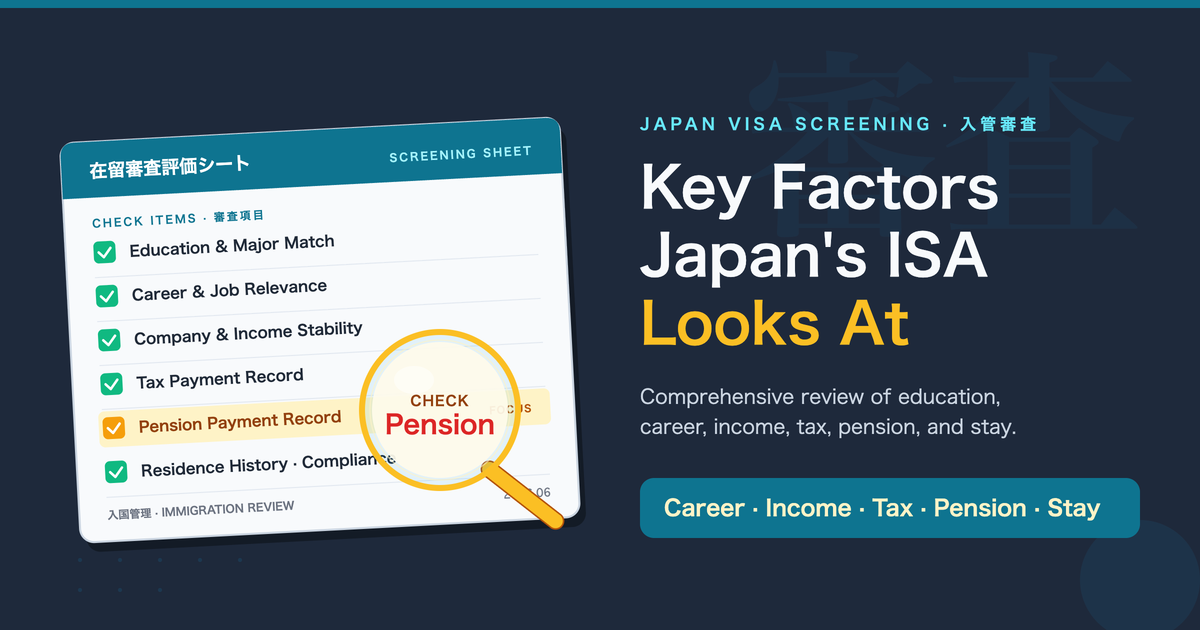
When preparing for a Work Visa, Spouse Visa, Business Manager Visa, or Permanent Residence application in Japan, most people have one burning question.
“What exactly does Immigration look at when reviewing my case?”
“Is a high salary all that matters?”
“Why does one person get approved while another gets rejected?”
Japanese visa screening is not simply a matter of submitting a stack of documents. The Immigration Services Agency (ISA), also known as Immigration Bureau (Nyukan), reviews each applicant’s situation comprehensively — confirming whether your purpose of stay is clear, whether you can support yourself stably, and whether your activities match your Status of Residence.
This article walks through the key factors that Japan weighs most heavily during visa screening.
Japan’s visa screening is closer to a holistic evaluation than you might think
Many people assume things like:
“If my salary is above a certain amount, I’ll pass.”
“If my company is big enough, I’ll get approved.”
In reality, the review is far more multifaceted. The Immigration Bureau evaluates applicants on:
- Educational background
- Work history
- Employer
- Income level
- Residence history
- Tax payments
- Pension payments
In other words, excelling in just one area does not guarantee approval.
1. Does your Status of Residence match your actual activities?
This is one of the single most important factors.
For example, if you apply for the Work Visa category known as Engineer / Specialist in Humanities / International Services (技術・人文知識・国際業務) but your day-to-day tasks are primarily manual or unskilled labor, that inconsistency can become a serious problem.
The Immigration Bureau scrutinizes:
“Do the applicant’s actual job duties align with the Status of Residence they are applying for?”
This is why job description documents and employment contracts are reviewed in detail.
2. Is your educational background relevant to the job?
This is especially important for Work Visa screenings.
For example:
- IT degree → software developer role
- Business administration degree → marketing position
These connections are relatively straightforward to explain.
On the other hand, if your field of study and your job are quite different, you may need to provide additional explanations covering:
- Related work experience
- Practical skills
- The employer’s rationale for hiring you
How educational background factors into visa screening is covered in more detail in Why Education Matters When Applying for a Japanese Visa.
3. Is your employer a stable company?
Company screening matters more than many people realize.
The Immigration Bureau also reviews the state of the hiring company, looking at factors such as:
- Company size
- Nature of business
- Revenue and financial condition
- Number of employees
- Tax compliance record
If a company was just recently established or its business operations are unclear, the screening process may become considerably stricter.
4. Is your income at a stable level?
Salary is one important factor in visa screening.
However, it is not simply:
“High salary = automatic approval.”
The Immigration Bureau checks:
- Whether the income is sufficient to live on in Japan
- Whether it is unreasonably low relative to the job responsibilities
In particular, for Spouse Visa or Dependent Visa applications, the ability to financially support dependents is a key evaluation point. How income affects visa and period-of-stay decisions is covered in more detail in Why Income Matters in Japanese Visa Screening.
5. Tax payment record
This has become an increasingly critical factor in recent years.
Especially during visa renewals and Permanent Residence screenings, the Immigration Bureau carefully verifies records for:
- Resident Tax
- Income Tax
A history of unpaid taxes can work against you in screening. In fact, unpaid taxes are frequently cited as one of the top reasons for Permanent Residence rejections.
6. Pension payment record
This has grown far more important than it used to be.
The Immigration Bureau now closely checks payment records for:
- National Pension
- Employees’ Pension
For Permanent Residence screening in particular, this is essentially a mandatory checklist item. Even a brief lapse in payments can leave a record, so staying on top of this on an ongoing basis is important.
7. Health insurance payment status
Health insurance coverage is another key item under review.
Payment records for:
- National Health Insurance
- Social Insurance
can also be factored into the screening decision.
It is best to think of taxes, pension, and health insurance as one package that must be managed together.
8. Is your residence history clean?
The Immigration Bureau also reviews your past record in Japan.
Incidents such as:
- Illegal employment
- Violations of activities permitted outside your Status of Residence
- False declarations
- Failure to fulfill notification obligations
can all affect your screening outcome.
Conversely, a long track record of residing in Japan without any violations tends to be evaluated positively.
9. Are you living stably in Japan?
Ultimately, this is what the Immigration Bureau most wants to know:
“Can this person continue to live a stable life in Japanese society going forward?”
That is why the following factors carry so much weight:
- Steady employment
- Consistent income
- Full payment of taxes
- Full payment of pension contributions
- Full payment of health insurance premiums
In practice, people whose residence period is extended to three or five years very often meet all of these conditions. What traits characterize people who receive a longer period of stay is summarized in Who Gets a Longer Period of Stay in Japan? Key Traits That Matter.
Key points for Spouse Visa screening
The Spouse Visa has somewhat different screening criteria compared to a standard Work Visa.
The Immigration Bureau will typically look at:
- Whether the marriage is genuine
- Whether you are living together
- The circumstances of how you met and married
- Communication records
- Photographic evidence
The Immigration Bureau takes marriage fraud (sham marriages) extremely seriously. Documents that can demonstrate the history of your relationship and your actual living situation together are therefore essential.
Key points for Permanent Residence screening
Permanent Residence screening is considerably stricter than standard visa renewals.
The main areas evaluated include:
- Long-term residence history
- Full tax payment record
- Full pension payment record
- Full health insurance payment record
- Stable income
- Compliance with laws and regulations
In recent years, the importance of tax and pension records has increased significantly.
Common situations the Immigration Bureau views negatively
The following circumstances are likely to be evaluated unfavorably during screening:
- Submission of fraudulent documents
- Unpaid taxes
- Unpaid pension contributions
- Illegal employment
- Failure to meet notification obligations
- Mismatch between actual job duties and visa category
- Repeated rule violations
Once a problem arises, it can affect subsequent visa renewals and Permanent Residence applications as well.
Frequently asked questions
Does a high salary guarantee visa approval?
No. Salary matters, but education, work history, job content, and employer status are all evaluated together.
Does unpaid tax automatically lead to rejection?
It depends on the circumstances, but it is likely to work against you. For Permanent Residence screening in particular, it is examined very carefully.
Is it always an advantage to work at a large company?
Generally speaking, large employers tend to be viewed favorably in terms of stability, but that factor alone does not determine the outcome.
Wrapping up
Japanese visa screening is not a process decided by a few forms.
The Immigration Bureau reviews your educational background, work history, employer, income, taxes, pension, residence history, and more — all together — to make a judgment:
“Can this person live stably in Japan?”
In the end, the most important things are not exceptional skills or credentials, but rather:
- Paying taxes faithfully
- Paying pension contributions faithfully
- Maintaining stable employment
- Conducting activities appropriate to your Status of Residence
If you have your sights set on Permanent Residence in Japan, building the habit of carefully managing your tax records and residence history from the very beginning will serve you well.
Recommended Reading
- Why Work Experience Matters for Your Japan Visa Application — How much work experience counts and how to demonstrate it, just like education
- What Happens if You Have a Criminal Record When Applying for a Japan Visa? — How a criminal or regulatory violation history affects visa screening
- How Japanese Language Ability Affects Your Visa Application — How Japanese proficiency such as JLPT is evaluated in screening
Need to apply for or change your status of residence in Japan?
Easily create your Japanese status of residence application.