Understanding Status of Residence: Essential Knowledge for Long-Term Stay in Japan
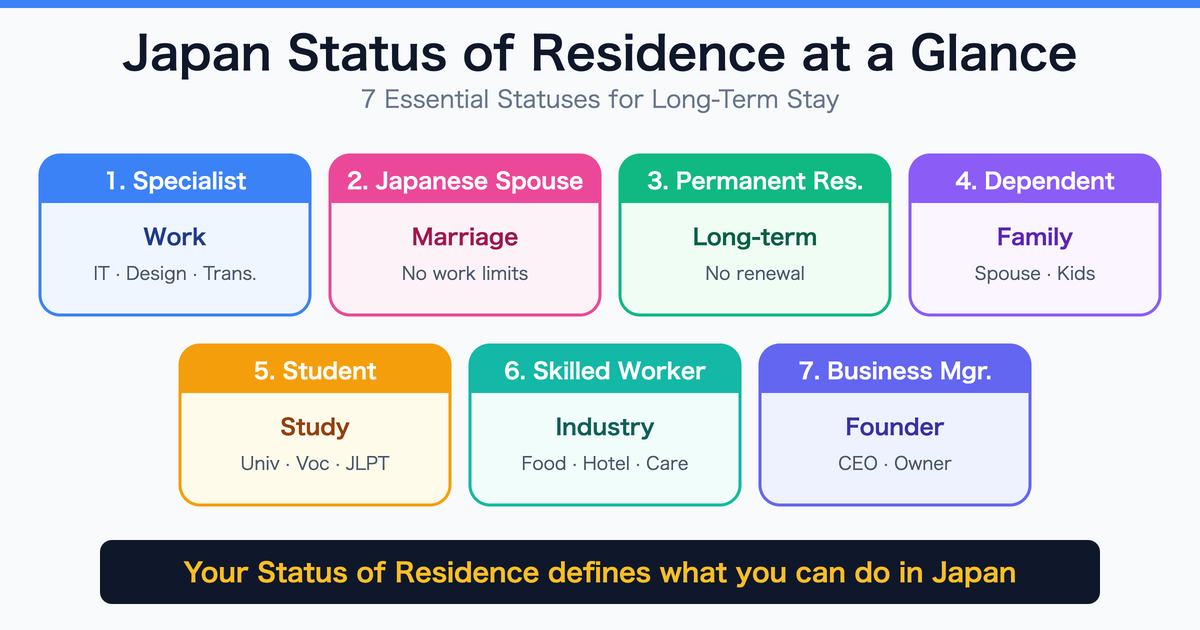
If you want to work, get married, study, or live in Japan for an extended period, there is one concept you absolutely must understand: Status of Residence (在留資格).
Many people use the term “Japan visa,” but for foreigners actually living in Japan, what matters far more than the visa is the Status of Residence.
In this article, we will clearly explain the concept and types of Status of Residence that anyone planning a long-term stay in Japan needs to know.
What Is Status of Residence?
Status of Residence is the authorization that defines what purpose a foreign national is permitted to stay in Japan for.
In simple terms, think of it as official government recognition of the following kinds of activities:
- Authorization to work in Japan
- Authorization to study in Japan
- Authorization to live in Japan as the spouse of a Japanese national
- Authorization to reside in Japan with family
After entering Japan, your Status of Residence as listed on your Residence Card has a far greater impact on daily life than the visa stamp in your passport.
How Is a Visa Different from Status of Residence?
This is a point that confuses many people. A visa and Status of Residence may look similar, but they are entirely different systems with different roles and issuing authorities.
Visa
A visa is the concept of an entry recommendation issued by a Japanese embassy or consulate abroad that allows you to enter Japan.
In other words, it essentially means: “This person is approved to enter Japan.”
Status of Residence (在留資格)
Status of Residence is the system that determines what activities you are permitted to carry out once you are inside Japan.
For example, it decides the following:
- Whether you can work at a company
- Whether you can attend school
- Whether you can take a part-time job
- Whether you can run a business
For long-term stays in Japan, Status of Residence is far more important than a visa.
Why Does Status of Residence Matter?
What you are allowed to do depends entirely on your Status of Residence.
For example, international students are in Japan primarily to study and cannot freely take up employment. In contrast, someone on a Work Visa can work at a company but may be restricted to specific job types or duties. Someone on a spouse visa, however, can work freely with no restrictions on job type.
In other words, even among foreign nationals, rights and obligations differ significantly depending on Status of Residence.
7 Major Types of Status of Residence in Japan
Japan has around 30 types of Status of Residence, but the following 7 are the ones most commonly encountered.
1. Engineer / Specialist in Humanities / International Services (技術・人文知識・国際業務)
This is the most common Work Visa.
Main eligible job types
- IT engineers
- Web developers
- Designers
- Marketers
- Sales
- Trade specialists
- Interpreters and translators
The majority of foreign professionals working in Japan hold this Status of Residence.
2. Spouse or Child of Japanese National (日本人の配偶者等)
This is the Status of Residence available to those who are married to a Japanese national.
Key features
- No restrictions on employment
- No restrictions on job type
- Self-employment is permitted
- Advantageous when applying for Permanent Residence
3. Permanent Resident (永住者)
This is the status held by those who have obtained Japanese Permanent Residence.
Key features
- Almost no renewal burden
- No occupational restrictions
- Often advantageous in loan screening
This is the Status of Residence that many foreign nationals aim for as their long-term goal.
4. Dependent (家族滞在)
This is the Status of Residence for family members of Work Visa or Student Visa holders to reside together in Japan.
It primarily covers spouses and children. With Permission for Activities Outside Status of Residence, part-time work is permitted within 28 hours per week. (Based on Immigration Services Agency criteria for permission for activities outside status of residence)
5. Student (留学)
This is the Status of Residence for studying at a school in Japan.
Eligible schools
- Japanese language schools
- Vocational schools
- Universities
- Graduate schools
With Permission for Activities Outside Status of Residence, part-time work is allowed, subject to the following time limits:
- During the academic term: up to 28 hours per week
- During long vacation periods as defined by school regulations: up to 8 hours per day, 40 hours per week
Note that part-time work in businesses classified as adult entertainment or related industries (pachinko parlors, mahjong parlors, game centers, hostess bars, etc.) is prohibited.
6. Specified Skilled Worker (特定技能)
This is a system created to accept foreign workers in industries facing labor shortages.
Representative industries
- Food service
- Accommodation
- Nursing care (介護)
- Construction
- Agriculture
This is a Status of Residence that the Japanese government is actively expanding.
7. Business Manager (経営・管理)
This is the Status of Residence for foreign nationals who wish to operate a business in Japan.
Covered activities
- Establishing a company
- Operating a business
- Acting as a corporate representative
It is widely used by those planning to start a startup or expand a business into Japan.
Status of Residence and Period of Stay Are Different Things
Status of Residence and period of stay are two separate concepts.
For example, even if your Status of Residence is “Engineer / Specialist in Humanities / International Services,” the period of stay can vary as follows:
- 1 year
- 3 years
- 5 years
In other words, think of it this way:
- Status of Residence = what activities you are permitted to do
- Period of stay = how long you are permitted to remain
The Difference Between Status of Residence and Permanent Residence
Permanent Residence is itself one type of Status of Residence. However, unlike other statuses, it comes with almost no restrictions on activities.
For example, a Work Visa requires you to perform specific duties, but a Permanent Resident can freely engage in the following:
- Company employee
- Self-employed individual
- Freelancer
- Investor
This is why many foreign nationals aim for Permanent Residence as their ultimate goal for long-term settlement in Japan. For the specific advantages of Permanent Residence, see Benefits of Obtaining Permanent Residence from a Work Visa in Japan.
Common Mistakes
Here is a summary of typical misunderstandings that arise from a poor understanding of Status of Residence.
”As long as I have a visa, I can do any kind of work”
This is incorrect. Activities that fall outside the scope of your Status of Residence constitute a violation and can result in the following penalties:
- Criminal punishment: imprisonment or imprisonment without work for up to 1 year, or a fine of up to 2 million yen (Immigration Control Act, Article 73)
- Engaging in activities outside status of residence as a primary occupation: imprisonment or imprisonment without work for up to 3 years, or a fine of up to 3 million yen (Immigration Control Act, Article 70)
- Deportation: constitutes grounds for deportation under Article 24 of the Immigration Control Act
- Cancellation of Status of Residence and unfavorable treatment in future applications to change or renew status
Employers (companies) may also be subject to penalties of imprisonment or imprisonment without work for up to 3 years, or a fine of up to 3 million yen, for facilitating illegal employment.
”With a Work Visa, I can freely change jobs to any company”
Depending on the nature of the work, it may not match your Status of Residence. When changing jobs, always confirm that the new duties fall within the permitted scope of activities for your current Status of Residence.
”My period of stay hasn’t expired, so there’s no problem”
If you leave a company and remain unemployed for an extended period (generally 3 months or more), the Immigration Services Agency may determine that grounds exist for cancellation of your Status of Residence.
Conclusion
If you plan to live in Japan for the long term, Status of Residence is the first thing you need to understand.
Status of Residence is not merely a permit to stay — it is a critical system that determines what activities you are allowed to carry out in Japan. Selecting the right Status of Residence for your purpose — whether work, marriage, study, or starting a business — and understanding the rules that apply to it is the first step toward a stable life in Japan.
If you are aiming for Permanent Residence in particular, it is important to understand the characteristics and renewal conditions of your current Status of Residence in advance. If you are wondering about the actual application process, please also refer to The Complete Guide to the Status of Residence Application Process.
References
- Immigration Services Agency - Required Documents by Status of Residence
- Immigration Services Agency - Application for Certificate of Eligibility
- Immigration Services Agency - Application for Permission for Permanent Residence
- Immigration Services Agency - Permission for Activities Outside Status of Residence
Need to apply for or change your status of residence in Japan?
Easily create your Japanese status of residence application.