Permitted Activities by Status of Residence in Japan
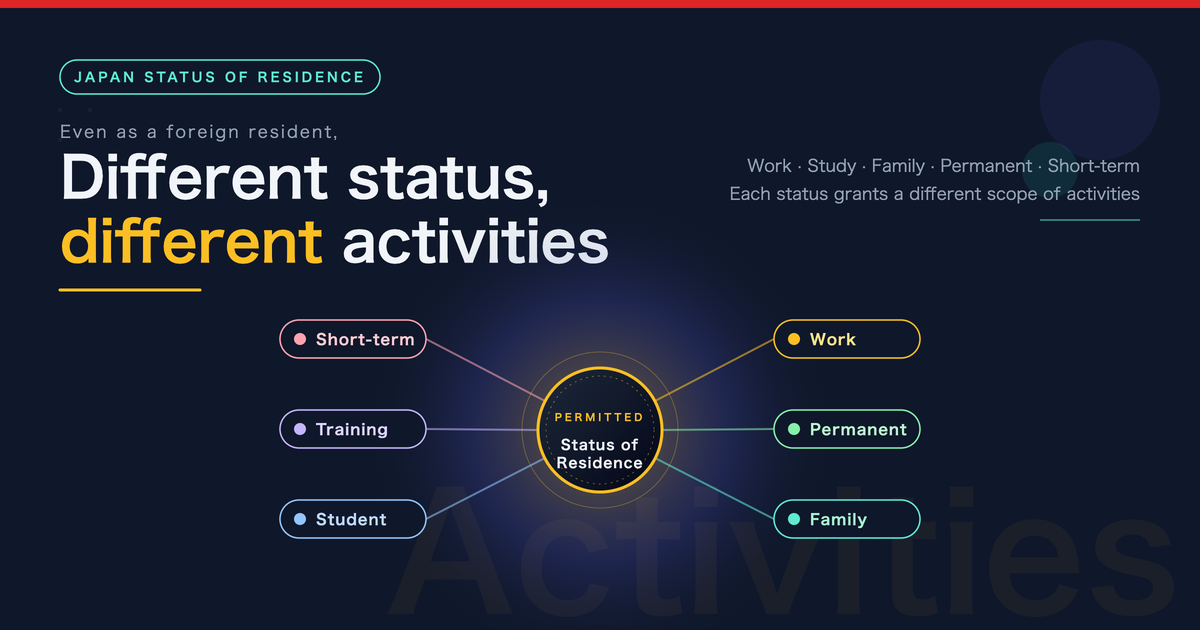
If you plan to stay in Japan long-term, you must hold a valid Status of Residence (在留資格). Many people loosely call it a “visa,” but strictly speaking, your Status of Residence is what determines what you are permitted to do while living in Japan.
There is an important point to keep in mind: the activities you are allowed to engage in differ depending on your Status of Residence. Even if you are legally residing in Japan, doing something outside the scope of your status can lead to serious problems.
This article summarizes the permitted activities for each major Status of Residence in Japan.
What Is a Status of Residence?
A Status of Residence is a system that defines what purpose a foreign national may stay in Japan for.
Common purposes include:
- Staying to work
- Staying to study
- Staying to live with family
- Staying to run a business
In other words, Japan grants residency based on “why you are staying in Japan.”
Engineer / Specialist in Humanities / International Services (技術・人文知識・国際業務)
This is the most common work-related Status of Residence in Japan. Permitted activities include:
- IT engineering
- Systems development
- Planning and strategy
- Marketing
- Accounting
- Human resources
- Trade operations
- Interpreting and translation
- International sales
This status generally covers work that is directly related to your university major or specialist knowledge.
Things to Watch Out For
Performing only unskilled labor can be a problem. For example, simple factory work or basic food serving are generally not covered under this status.
Highly Skilled Professional (高度専門職)
This status is designed for highly skilled foreign professionals. It applies to fields such as:
- Researchers
- Advanced engineers
- Specialist professionals
It comes with more benefits than a standard work visa, including:
- Priority pathway to Permanent Residence
- Expanded work rights for spouses
- Partial allowance for inviting parents to Japan
Business Manager (経営・管理)
This status is for people who operate or manage a company in Japan. Permitted activities include:
- Establishing a company
- Running a corporation
- Managing a business
- Overseeing business operations
This is different from working as a regular employee.
Skilled Labor (技能)
This status is for people with specific technical skills or craftsmanship. Common occupations include:
- Chefs (especially those specializing in foreign cuisine)
- Sports instructors
- Aircraft maintenance technicians
- Precious metal workers
Proven professional experience in the relevant skill is an important requirement.
Specified Skilled Worker (特定技能)
This status was introduced to allow foreign workers into industries facing labor shortages. Target industries include:
- Food service
- Accommodation / hospitality
- Nursing care
- Construction
- Agriculture
- Food manufacturing
Most roles are hands-on, practical positions.
Technical Intern Training (技能実習)
This status is for foreign nationals learning technical skills in Japan.
Its original purpose is technology transfer, but in practice it is widely used in manufacturing, agriculture, and similar industries. There has been ongoing discussion in recent years about reforming the program.
Student (留学)
This status is for foreign nationals enrolled in a school in Japan. It applies to:
- Japanese language schools
- Vocational schools
- Universities
- Graduate schools
Can Students Work Part-Time?
The primary purpose of this status is studying. However, students can work part-time within permitted limits if they obtain an Activity Outside the Scope of Status of Residence permit (資格外活動許可).
Dependent (家族滞在)
This status allows family members of work visa holders to reside in Japan. It typically covers spouses and children.
Can Dependents Work?
Unrestricted employment is not permitted. However, dependents can work part-time within limits if they obtain an Activity Outside the Scope permit.
Spouse or Child of Japanese National (日本人の配偶者等)
This is the typical status granted to those who are married to a Japanese national.
Key Features
There are relatively few activity restrictions. Employment is permitted. For example, the following activities are allowed:
- Company employment
- Self-employment
- Freelance work
Permanent Resident (永住者)
This is one of the most unrestricted statuses available in Japan.
Permitted Activities
There are virtually no occupation restrictions. Permitted activities include:
- Company employment
- Self-employment
- Freelance work
- Part-time work
Renewal requirements are also much less burdensome. The specific benefits gained when obtaining permanent residence are summarized in Benefits of Obtaining Permanent Residence from a Work Visa in Japan.
Long-Term Resident (定住者)
This status is granted to people who are permitted to reside in Japan for specific reasons, such as:
- Japanese descendants (Nikkei)
- Special family circumstances
Similar to Permanent Resident, the range of permitted activities is broad.
Cultural Activities (文化活動)
This status is for people engaged in cultural or academic activities in Japan. Common examples include:
- Research into traditional Japanese arts
- Artistic activities
- Academic research
Employment for income is generally not permitted under this status.
Temporary Visitor (短期滞在)
This status covers short-term stays for tourism or business trips. Common purposes include:
- Sightseeing
- Visiting family or friends
- Business trips
Can Temporary Visitors Work?
No. Working on a tourist visa constitutes illegal employment and can result in serious consequences.
Activities Outside Your Status of Residence Can Be Dangerous
Engaging in activities beyond the scope of your Status of Residence in Japan can lead to serious problems. Examples include:
- Unauthorized employment while on a Student visa
- Working while on a Temporary Visitor (tourist) visa
- Performing work that is not permitted under your work visa
In serious cases, this can result in visa cancellation or deportation. What violations actually lead to deportation is summarized in Japan Deportation Cases: What Leads to Forced Removal?.
What Is an Activity Outside the Scope of Status of Residence Permit?
This is a system that allows you to partially engage in activities beyond your original Status of Residence. Common examples include:
- Part-time work for international students
- Part-time work for Dependents
Working without obtaining this permit can cause significant legal problems.
Which Statuses Permit Employment?
Employment Permitted
- Engineer / Specialist in Humanities / International Services (技術・人文知識・国際業務)
- Highly Skilled Professional (高度専門職)
- Business Manager (経営・管理)
- Specified Skilled Worker (特定技能)
- Permanent Resident (永住者)
- Spouse or Child of Japanese National (日本人の配偶者等)
- Long-Term Resident (定住者)
Restricted or Generally Not Permitted
- Student (留学)
- Dependent (家族滞在)
- Cultural Activities (文化活動)
- Temporary Visitor (短期滞在)
Note: some of these statuses allow limited part-time work with an Activity Outside the Scope permit.
Frequently Asked Questions
Is a Japanese visa the same as a Status of Residence?
They are often used interchangeably, but they are technically different. While you are in Japan, your actual permitted activities are governed by your Status of Residence, not the entry visa.
Can international students work part-time?
Yes, if they obtain an Activity Outside the Scope of Status of Residence permit.
Are there work restrictions for a spouse visa?
In general, employment restrictions are relatively few.
Can I work on a tourist visa?
No. Doing so constitutes illegal employment and can lead to serious consequences.
Conclusion
Your Status of Residence in Japan is not simply permission to stay in the country — it is the framework that determines what activities you are legally allowed to carry out.
Even among foreign nationals, the permitted activities vary greatly depending on whether you hold a work visa, student visa, spouse visa, or Permanent Residence.
In particular, engaging in activities outside the scope of your Status of Residence can lead to immigration violations, so it is essential to clearly understand what your current status permits.
For a stable life in Japan, managing not just your period of stay but also staying within the permitted scope of your Status of Residence is a critically important point.
Recommended Reading
- Understanding Status of Residence: Essential Knowledge for Long-Term Stay in Japan — How status of residence differs from a visa: a summary of the basic concepts
- Japan Residence Period: 1-Year, 3-Year, and 5-Year Differences — Differences in residence period granted by status and the criteria for determination
- Key Factors Japan Looks at When Screening Your Visa — A comprehensive summary of the factors immigration evaluates across visa screenings
Need to apply for or change your status of residence in Japan?
Easily create your Japanese status of residence application.