Complete Guide to Notification Obligations for Foreigners in Japan
For foreigners on long-term stays in Japan, simply maintaining a valid visa is not enough.
Daily life in Japan comes with a variety of notification obligations.
Many people assume:
“I just need to register my address, right?”
“Do I really have to notify anyone if I change jobs?”
“Does getting married or divorced require a notification too?”
However, failing to fulfill these obligations can cause problems when renewing your visa or applying for permanent residence down the line.
This article summarizes the key notification obligations that foreigners living in Japan should be aware of.
Why Do Notification Obligations Matter?
Japan manages the residence information of foreigners relatively strictly.
The Immigration Services Agency monitors your situation based on information such as:
- Address
- Workplace
- Spouse
- Status of residence
Neglecting required notifications can therefore lead to:
- Administrative fines
- Disadvantages in reviews
- Issues with your status of residence
Address-Related Notifications
Change of Address Notification
This is the most common notification obligation.
If you move within Japan, you are required to report your new address.
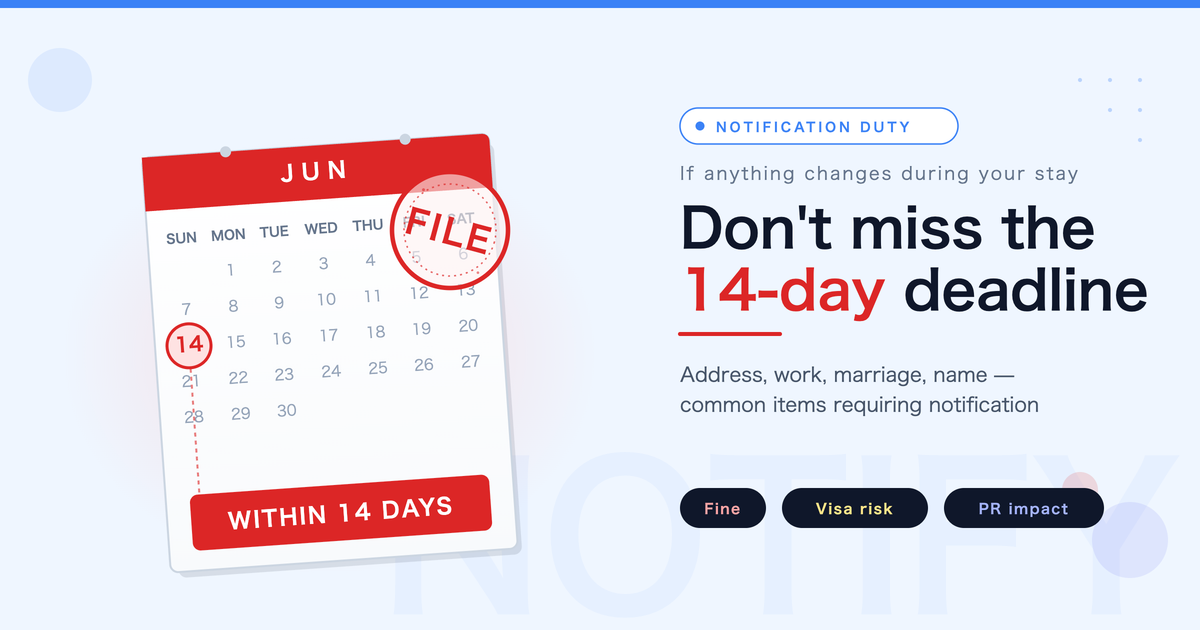
As a general rule, notification must be completed:
Within 14 days of moving
Notifications are submitted at the city or ward office of your new place of residence.
Updating Your Residence Card Address
When you change your address, it is not just your resident registration that changes — the address information on your residence card is also updated at the same time.
It is therefore advisable to complete the process as soon as possible after moving.
Workplace and Affiliated Institution Notifications
Change of Workplace Notification
If you hold a work visa and your affiliated organization changes, a notification obligation may arise.
Examples include:
- Leaving a company
- Changing jobs
- A change in your company’s name
The Immigration Bureau checks whether you are engaging in activities consistent with your current status of residence, so workplace information is important.
Notification After Leaving a Job
If you leave a company while on a work visa, you may be subject to a related notification requirement.
In particular, if a prolonged period of unemployment continues, it may affect future visa reviews.
Notification After Changing Jobs
A notification may also be required when you move to a new company.
This is one of the points that many people overlook.
Affiliated Institution Notification
Certain statuses of residence require notification regarding affiliated institutions.
Notable examples include:
- Engineer / Specialist in Humanities / International Services
- Student
If your school or company changes, you may be required to submit a notification.
Change of School for International Students
If an international student:
- Transfers to another school
- Withdraws voluntarily
- Is expelled
a related notification may be required in some cases.
Marriage and Spouse-Related Notifications
Spouse-Related Notifications
Holders of a spouse visa may be required to notify the authorities of changes in their marital status.
For example, in the event of:
- Divorce
- Death of a spouse
a notification obligation arises.
This is because a spouse visa is a status of residence premised on the existence of a marital relationship.
Information Changes Following Marriage
If marriage results in:
- A change of given name
- A change of surname
a related notification may also be required.
Divorce Notification for Spouse Visa Holders
This is a point that many people overlook.
If you divorce while holding a spouse visa, there is a related notification obligation.
Neglecting this can affect future residence-related procedures.
Personal Information Change Notifications
Name Change Notification
If your name changes due to a legal name change or marriage, you are required to notify the authorities of the change to the particulars on your residence card.
If your passport information has changed, it is advisable to update your residence card at the same time. The procedures you need to take care of when your name changes are covered in detail at What to Do When Your Name Changes While Living in Japan.
Change of Nationality Notification
A change of nationality is also a matter that requires notification.
The Immigration Bureau requires that residence card information be kept up to date.
Corrections to Date of Birth or Sex
Although rare, if a correction to your passport information results in a change to your:
- Date of birth
- Sex
a notification may also be required in some cases.
Residence Card-Related Notifications
Reporting a Lost Residence Card
If you lose your residence card, you must act quickly.
The general steps are:
- Filing a report with the police
- Applying for a reissue
Your residence card is one of the most important forms of identification while living in Japan.
Do Permanent Residents Also Have Notification Obligations?
Yes, they do.
Although permanent residents enjoy greater stability of residence, they are still responsible for managing:
- Changes of address
- Name changes
- Residence card renewals
Residence Card Renewal Is Also Important
Permanent residents do not need to renew their period of residence, but they are still required to renew the residence card itself.
Surprisingly, many people miss this. The benefits of permanent residence itself are summarized at Benefits of Obtaining Permanent Residence from a Work Visa in Japan.
What Happens If You Don’t Notify?
While it depends on the situation, the following may occur:
- Administrative fines
- Administrative disadvantages
- Unfavorable treatment in visa reviews
In particular, compliance with laws and regulations is an important factor that is checked during permanent residence reviews.
How Does the Immigration Bureau Find Out?
In Japan, information is sometimes shared between multiple government agencies.
Checks may also be carried out through:
- Tax records
- Resident registration
- Residence information
For this reason, thinking:
“They probably won’t find out”
can be risky.
When You’re Unsure Whether a Notification Is Required
Whether a notification is required can vary depending on the situation.
In ambiguous cases, it is best to check with:
- The Immigration Services Agency
- Your city or ward office
- An administrative scrivener (gyoseishoshi)
Frequently Asked Questions
Do I have to notify the authorities when I move?
Yes. As a general rule, you are required to notify within 14 days of changing your address.
Do I need to file a notification when I change jobs?
Depending on your status of residence, notification of a change in affiliated institution may be required.
Do I need to file a notification if I divorce while on a spouse visa?
Yes. There is a related notification obligation.
Do permanent residents have notification obligations?
Changes of address, name changes, and similar matters are still subject to notification.
Conclusion
Foreigners on long-term stays in Japan need to manage a range of notification obligations in addition to simply maintaining a valid visa.
In particular, the following are notifications that frequently arise in daily life in Japan:
- Address changes
- Workplace changes
- Changes to spouse-related information
- Name changes
- Residence card management
Failing to submit these notifications on time can result in disadvantages when renewing your visa or applying for permanent residence.
To build a stable life in Japan, it is important to develop the habit of keeping on top of your notification obligations alongside managing your period of residence.
Since more people overlook these requirements than you might expect, knowing about them in advance can make a real difference.
Recommended Reading
- How to Receive Your Residence Card Upon Arriving in Japan — How your residence card is issued and received, and your first steps after arriving in Japan
- What Is Japan’s Immigration Services Agency? — The role of the agency that receives and manages notifications, and its key responsibilities
- Key Factors Japan Looks at When Screening Your Visa — How compliance with notification obligations is weighted in visa renewal and permanent residence reviews
Need to apply for or change your status of residence in Japan?
Easily create your Japanese status of residence application.