Common Reasons for Work Visa Rejection in Japan
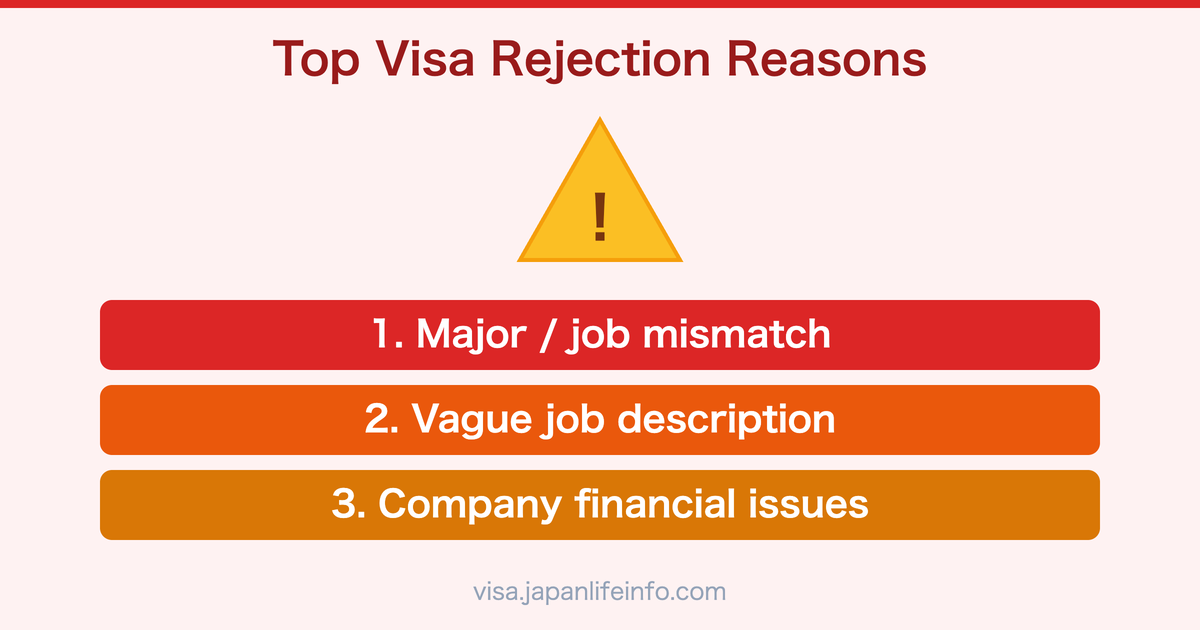
There are cases where work visas are rejected even after getting a job offer from a Japanese company.
Many people think:
“I got the job, so the visa will obviously be approved…”
But Japanese work visa screening is a separate matter from getting the job offer.
The screening is handled by the Immigration Services Agency — it’s the “government” that decides, not the company.
So why do rejections happen? Let’s look at the main reasons for rejection and specific ways to address them.
1. Mismatch Between Major and Job Duties
This is the most common reason for rejection.
The work visa (Engineer/Specialist in Humanities/International Services) requires relevance between education or career experience and job duties.
Cases Prone to Rejection
| Major | Applied Job | Judgment |
|---|---|---|
| Economics | Software Engineer | Insufficient relevance → High chance of rejection |
| Japanese Language | IT System Development | Insufficient relevance → High chance of rejection |
| Design | Trade Office Work | Insufficient relevance → High chance of rejection |
| Business Administration | Overseas Sales/Marketing | Relevance recognized → High chance of approval |
| Information Engineering | Systems Engineer | Directly related → High chance of approval |
How to Address This
- Clearly state the specific connection between your major subjects and the job duties in the job description letter
- Attaching a list of relevant courses taken at university is effective
- If your minor or double major is in a related field, be sure to mention it
2. Vague Job Description
The Immigration Services Agency asks this question: “Is this truly a specialized job?”
If the job description written by the company is too abstract or focused on simple tasks, it will be deemed lacking in specialization.
Risky Expressions and Improved Examples
| Risky Expression | Improved Example |
|---|---|
| ”Store management" | "Handling foreign customers and developing multilingual marketing strategies" |
| "Customer service" | "Coordinating technical specifications with overseas clients and managing projects" |
| "Document filing" | "Preparing trade documents (B/L, invoices) and managing customs clearance work" |
| "Interpretation/Translation" | "Translating technical documents and interpreting/coordinating Japan-overseas technical meetings” |
The job description must clearly show why specialized knowledge is required for that particular job.
3. Company Financial Issues
It is not always the applicant’s problem — many rejections are due to company issues.
Points the Immigration Services Agency looks at:
- Business stability: Companies with continued losses raise doubts about the sustainability of employment
- Business continuity: Newly established companies have no business track record, so screening is strict
- Ability to pay salary: Whether the company can actually pay the promised salary
Screening Difficulty by Affiliated Organization Category
| Category | Applicable Organizations | Screening Difficulty |
|---|---|---|
| Category 1 | Listed companies, government agencies, etc. | Low (simplified documents) |
| Category 2 | Withholding tax amount of 10 million yen or more | Moderate |
| Category 3 | Withholding tax amount less than 10 million yen | High (detailed documents required) |
| Category 4 | Newly established companies, etc. | Very high (additional documents such as business plan required) |
How to Address This
- Category 3 and 4 companies should also submit a business plan, client list, and future revenue projections
- Companies with losses should specifically present a plan for returning to profitability
- Newly established companies should demonstrate business stability through the representative’s career history, initial investment track record, and transaction contracts
4. Salary Below Japanese Average
Japanese work visas require compensation equal to or higher than what Japanese workers receive. This is a requirement specified in the Immigration Control Act.
Screening Standards
- Compared to the average salary of Japanese workers in the same industry and job type
- Confirmed to be above the regional minimum wage
- Judged by total compensation including base salary, allowances, and bonuses
An excessively low salary raises the suspicion: “Isn’t this actually simple labor?”
How to Address This
- Check the appropriate salary level by referring to the Ministry of Health, Labour and Welfare’s “Basic Survey on Wage Structure”
- If there is a reasonable reason why the salary is below average, explain it in a statement of reasons (e.g., probationary period)
5. Insufficient Career Experience
If educational requirements are lacking, relevant work experience in the field becomes the alternative requirement.
Educational and Career Requirements by Status of Residence
| Status of Residence Category | Educational Requirement | Alternative Career Requirement |
|---|---|---|
| Technical field | Science/engineering university graduate | 10+ years of experience in a related field |
| Humanities field | University graduate | 10+ years of experience in a related field |
| International services field | University graduate | 3+ years of experience in a related field |
How to Address This
- When documenting career history, include specific job duties, a list of projects, and job titles in detail
- Be sure to obtain an employment certificate (certificate of employment) from your previous company
- For vocational school graduates, explain the connection between your specialization and the job duties in even more detail
6. Past Residency Issues
If you have any of the following history, screening becomes stricter.
- Illegal stay (overstay): A history of illegal stay is grounds for entry denial for a considerable period (usually 5 years)
- Unauthorized activities violation: Working more than 28 hours per week on a student visa, etc.
- Unpaid taxes or insurance: Unpaid residence tax and national health insurance premiums are disadvantageous not only for permanent residence but also for renewals and changes
- Salary issues at previous employer: Failure to enroll in employment insurance or social insurance, etc.
Especially when applying for a status change within Japan, all past records are thoroughly checked.
How to Address This
- If you have unpaid taxes or insurance, pay them in full before applying
- If you have a history of unauthorized activities violations, submitting a statement of reasons and a letter of reflection may be taken into consideration
- Depending on the severity of past issues, consulting an administrative scrivener is strongly recommended
7. Insufficient Documents
This is a surprisingly common cause of rejection. The Immigration Services Agency judges solely based on what is written in the documents.
Frequently Occurring Document Problems
- Missing or expired graduation certificate
- Unclear employment certificate (job duties not stated)
- Insufficient job description letter content
- Missing Japanese translation of foreign-language documents
- Photo not meeting specifications (see ID Photo Specifications Guide)
- Inconsistencies between information on the application form and attached documents
How to Address This
- Create a checklist before submission and verify each item one by one
- Cross-check the consistency of dates, amounts, and job duties across documents
- Foreign-language documents must include a Japanese translation + translator’s signature
Overall Strategy to Avoid Rejection
| Strategy | Description |
|---|---|
| Write specific job descriptions | Make it clear “why specialized knowledge is required for this job” |
| Organize the logical connection between major/career and job | Logical connection between resume and job description |
| Confirm salary standards | Equal to or above the Japanese average for the same job type |
| Submit sufficient company financial documents | Category 3 and 4 require thorough preparation of additional documents |
| Include translations of all documents | Japanese translation is required for foreign-language documents |
| Review past residency history | Confirm taxes and insurance are fully paid, prepare for any violation history |
How to Handle Rejection
There is no need to give up just because your visa was rejected.
Reapplication
- After confirming the reason for rejection, you can reapply after addressing that reason
- There is no limit on the number of reapplications
- However, reapplying with the same content is likely to result in rejection again, so be sure to reflect improvements
Consulting a Professional
- After rejection, consulting an administrative scrivener (行政書士) is strongly recommended
- An administrative scrivener will analyze the reason for rejection and help develop a strategy for reapplication
- While there is a cost involved, it can prevent the time and financial losses caused by repeated rejections
Considering Other Statuses of Residence
- If the desired status of residence is difficult to obtain, consider the possibility of other statuses of residence
- For example: if Engineer/Specialist in Humanities/International Services is difficult, consider a Specified Activities visa
Conclusion
Japanese work visas are judged not by “whether you got the job offer” but by whether legal requirements are met.
That is why rejections happen even after getting hired.
However, most rejections occur due to “insufficient document preparation.” By checking and preparing in advance for the 7 reasons for rejection explained above, you can significantly reduce the chance of rejection.
The real gateway to working in Japan is not the interview — it is the visa screening. To understand the full picture of the visa application process, also refer to the Status of Residence Application Process Guide.
Reference Links
Need to apply for or change your status of residence in Japan?
Easily create your Japanese status of residence application.