The Role of a Guarantor in Japanese Visa Applications
When preparing a Japanese visa application, you will likely come across an unfamiliar term: personal guarantor (身元保証人, mimoto hoshōnin).
In particular, those applying for the following statuses will often encounter guarantor-related documents:
- Spouse Visa
- Permanent Residence
- Long-Term Resident
- Certain other long-stay visa categories
At this point, many people have questions like these:
“What exactly does a guarantor do?”
“Is it like co-signing a loan?”
“Does being a guarantor carry heavy legal liability?”
“Does the guarantor have to be Japanese?”
This article breaks down the role of a guarantor in Japanese visa applications and what you need to know before asking someone to take on that responsibility.
What Is a Guarantor in the Japanese Visa Context?
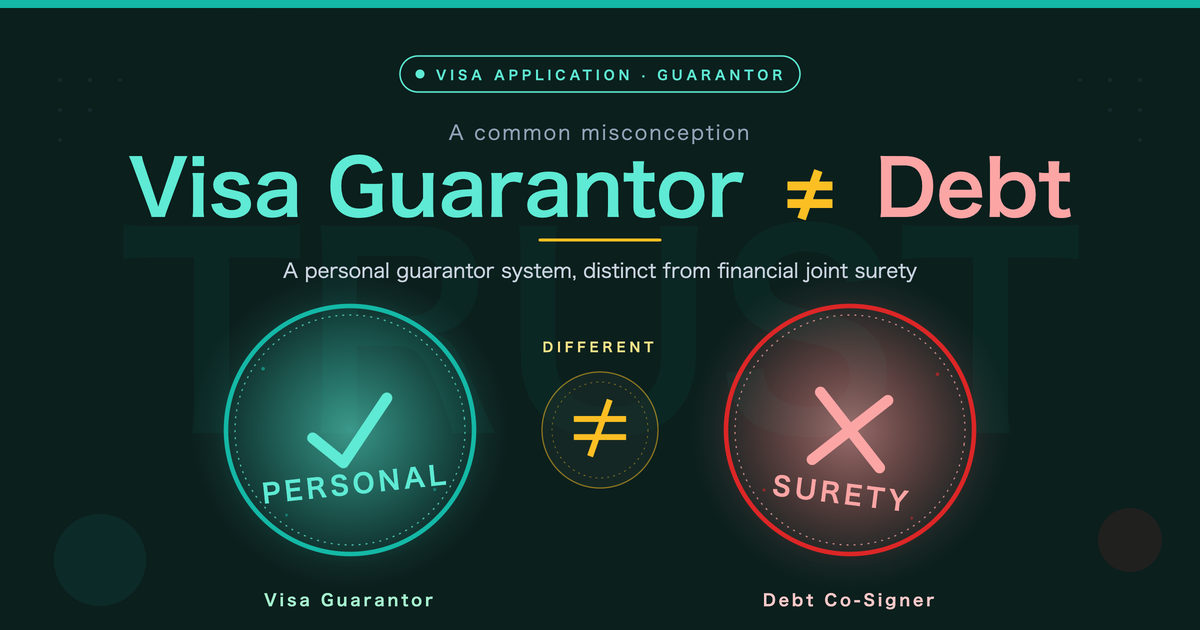
The guarantor referred to in Japanese visa screening is fundamentally different from a joint surety in financial or lending contexts.
In simple terms, a visa guarantor is best understood as:
“Someone who pledges to support the applicant in living a stable life in Japan.”
This means the guarantor is not legally obligated to repay the applicant’s debts the way a co-signer on a bank loan would be. This is a point that many people misunderstand.
Which Visa Categories Require a Guarantor?
The following Status of Residence categories commonly require a guarantor:
Spouse of a Japanese National
A guarantor is frequently required when applying for a Spouse Visa after an international marriage.
Permanent Residence
Submitting guarantor documentation is common practice in Permanent Residence applications.
Long-Term Resident
A guarantor may also be required when applying for Long-Term Resident status.
On the other hand, most standard work visas do not require a guarantor.
What Does a Guarantor Actually Do?
A guarantor generally pledges to support the applicant in the following areas:
- Compliance with Japanese laws and regulations
- General living support
- Assistance with return travel costs if necessary
That said, this is not the same as a legally binding joint surety arrangement with strong enforcement mechanisms.
Does the Guarantor Have to Pay the Applicant’s Debts?
This is the most common concern. The short answer is:
A visa guarantor is not the same as a loan co-signer.
For example, if the applicant fails to repay debts such as credit card balances, consumer loans, or living expenses, the guarantor is not automatically required to cover those debts.
This is why many Japanese nationals are willing to serve as guarantors for Permanent Residence applications — the actual burden is far less than many assume.
What Does Immigration Look for in a Permanent Residence Guarantor?
In a Permanent Residence application, the guarantor plays a supplementary role in reinforcing the credibility of the applicant.
The Immigration Services Agency may review the following details about the guarantor:
- Occupation
- Income
- Tax payment record
For this reason, guarantors are typically people who have stable employment and a solid financial standing. The factors that immigration comprehensively evaluates during visa screening are summarized in Key Factors Japan Looks at When Screening Your Visa.
Who Serves as the Guarantor for a Spouse Visa?
For a Spouse Visa, the Japanese spouse themselves most commonly serves as the guarantor.
In some cases, the following people may also take on the role:
- The spouse’s parents
- Other family members
Does the Guarantor Have to Be Japanese?
No, it does not have to be a Japanese national. In some cases, a permanent resident or a foreign national with stable, long-term residence in Japan can also serve as a guarantor.
However, the specific requirements may vary depending on the visa category.
What Are the Requirements to Become a Guarantor?
There is no officially published legal checklist, but the following qualities are generally considered appropriate:
- Stable income
- Residence in Japan
- Good tax payment record
- Social credibility and reliability
In Permanent Residence screenings in particular, a clean tax record tends to carry significant weight.
What Happens If There Is No Guarantor?
It depends on the visa type. When a guarantor is a required document, the application may not be able to proceed without one.
This is why it is important to confirm exactly which documents are needed well before submitting your application.
Documents the Guarantor Typically Submits
The required documents vary by situation, but common examples include:
- Personal guarantee form (身元保証書)
- Certificate of residence (住民票)
- Certificate of employment
- Certificate of taxable income
- Certificate of tax payment
The specific set of documents required will depend on the visa category.
What If the Guarantor’s Situation Changes Mid-Way?
It is not uncommon for a guarantor to move or change jobs after a visa has already been approved.
Generally speaking, a change in the guarantor’s circumstances alone will not cause a visa to be revoked. However, the most current information may be taken into account during future renewal or Permanent Residence procedures.
Guarantor vs. Sponsor: What Is the Difference?
This is a distinction that often causes confusion.
Sponsor (招聘人 / 身元引受人)
The person who has requested that the applicant visit or stay in Japan.
Guarantor (身元保証人)
The person who vouches for the applicant’s identity and ensures their stable life in Japan.
In some cases, the same person fulfills both roles simultaneously.
How Important Is the Guarantor in a Permanent Residence Application?
In Permanent Residence screening, the applicant’s own qualifications are by far the most important factor. The key elements are:
- Income
- Tax compliance
- Pension contributions
- Residence history
The guarantor plays a supporting role, not a deciding one. Having an outstanding guarantor will not override a weak application on the part of the applicant. The benefits of permanent residence itself and the key screening points are summarized in Benefits of Obtaining Permanent Residence from a Work Visa in Japan.
Why Some People Are Hesitant to Become a Guarantor
Some Japanese nationals feel uneasy when asked to be a guarantor simply because of the word itself.
However, once it is explained that a visa guarantor is categorically different from a financial joint surety, most people come to understand and are willing to help.
Frequently Asked Questions
Does a visa guarantor have to repay the applicant’s debts?
No. A visa guarantor is different from a financial joint surety and does not automatically assume responsibility for any debts.
Who can serve as a guarantor for Permanent Residence?
Generally, someone who has a stable lifestyle and resides in Japan is considered appropriate.
Does the guarantor have to be a Japanese national?
Not necessarily. Permanent residents and certain other foreign nationals may also qualify in some cases.
Do work visas require a guarantor?
Most standard work visas do not require a guarantor.
Summary
The guarantor in a Japanese visa application is a very different concept from a financial joint surety. Their role is to supplementally demonstrate that the applicant has a reliable identity and a stable foundation for life in Japan.
Guarantors are most commonly required for the following applications:
- Spouse Visa
- Permanent Residence
- Long-Term Resident
That said, the heart of any visa application lies with the applicant’s own circumstances — income, tax compliance, social insurance enrollment, and residence history are the most critical factors. The guarantor serves to complement those conditions, not replace them.
If you are preparing a Japanese visa application, understanding the true meaning of a guarantor and gathering the necessary documents in advance will help your application move forward smoothly.
Recommended Reading
- Understanding Status of Residence: Essential Knowledge for Long-Term Stay in Japan — Basic concepts for understanding the status of residence categories that require a guarantor
- Japan Residence Period: 1-Year, 3-Year, and 5-Year Differences — Residence periods and the criteria for determining them for permanent residence, spouse visas, and more
- What Is Japan’s Immigration Services Agency? — The role and key duties of the agency that reviews guarantor documents
Need to apply for or change your status of residence in Japan?
Easily create your Japanese status of residence application.