The Complete Guide to the Japanese Status of Residence Application Process
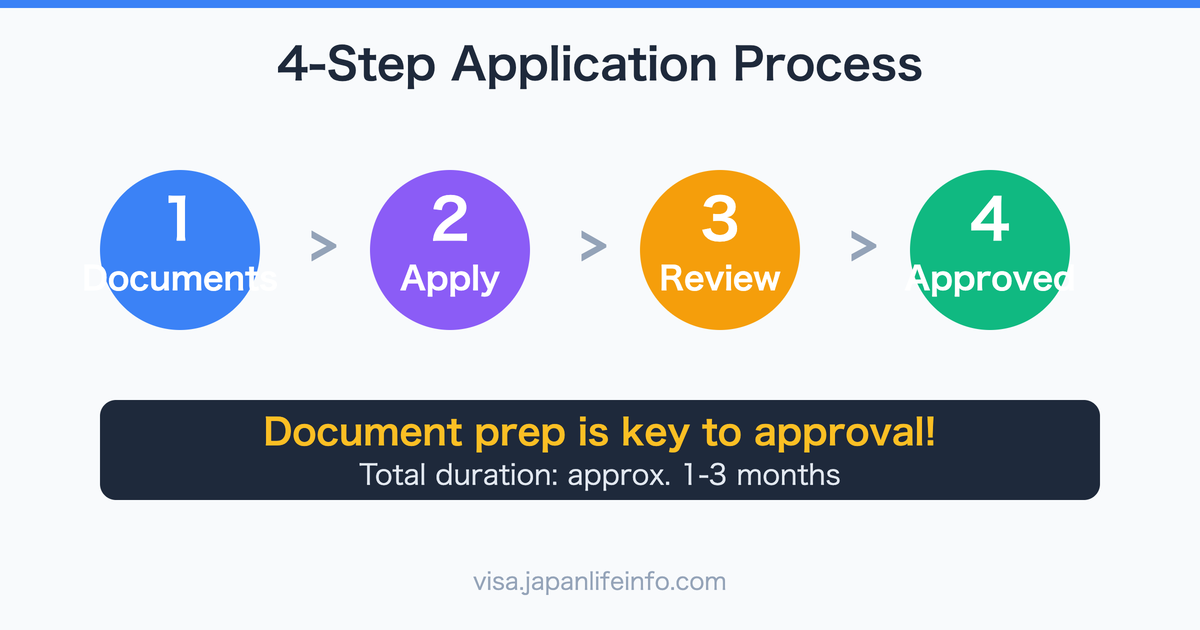
If you plan to stay in Japan long-term for employment, study, marriage, or starting a business, you must understand the status of residence (在留資格) system. For first-time applicants, the terminology can be unfamiliar and the procedures may seem complicated.
In this article, we provide only the practical, step-by-step procedures that you can apply directly to your actual application process.
Three Types of Status of Residence Applications
Status of residence applications are broadly divided into three types. First, check which type applies to your situation.
- Certificate of Eligibility (COE) Application (新規): For those entering Japan for the first time. Typically, a representative in Japan (company, school, etc.) submits the application to the Immigration Services Agency. For detailed procedures, see COE (Certificate of Eligibility) Issuance Process.
- Change of Status of Residence Application (変更): For those already residing in Japan who wish to change to a different status of residence. For example, changing from a student visa to a work visa.
- Extension of Period of Stay Application (更新): For those who wish to extend their period of stay while maintaining their current status of residence. Applications can be made starting 3 months before the expiration date.
1. Preparing Required Documents
Once you have determined the type of status of residence and application category, it is time to prepare your documents.
Commonly Required Documents
- Status of residence application form: Can be downloaded from the Immigration Services Agency website
- Passport and residence card: Make sure they have sufficient remaining validity
- ID photo: 4cm (height) x 3cm (width), taken within the last 3 months. For detailed specifications, see ID Photo Requirements Guide
- Revenue stamps for fee payment: Fees vary depending on the application type. For details, see Application Fees Guide
Additional Documents Based on Activity Type
The required documents vary significantly depending on the status of residence.
| Status of Residence | Main Additional Documents |
|---|---|
| Engineer/Specialist in Humanities/International Services | Employment contract, graduation certificate, resume, company registration certificate, financial statements |
| Student | Certificate of admission, certificate of enrollment, financial support letter |
| Spouse of Japanese National | Marriage certificate, spouse’s family register, questionnaire, snapshot photos |
| Business Manager | Business plan, office lease agreement, proof of investment |
| Permanent Residence | Certificate of employment, tax payment certificate, tax certificate, letter of guarantee |
You can check the list of required documents by status of residence on the Immigration Services Agency’s official website. Additional documents may frequently be requested depending on individual circumstances, so it is important to prepare with plenty of time.
Important Notes for Document Preparation
- Consistency across documents: The job duties on the employment contract must match the activities described on the application form
- Translations required: Documents in foreign languages must be accompanied by Japanese translations. Include the translator’s name and contact information
- Check validity periods: Graduation certificates, employment certificates, etc. should be issued within the last 3 months
- Originals and copies: Originals are required in principle, but copies may be accepted for some documents. If you need originals returned, request this at the counter
2. Submitting Your Application at the Immigration Bureau
Once all documents are ready, visit the Immigration Services Agency office with jurisdiction over your place of residence to submit your application.
Application Methods
There are two main application methods in Japan.
Counter Application (In-person)
- In principle, you must apply in person
- Proxy applications through administrative scriveners (行政書士) and other legal representatives are also possible
- No fee is charged at the time of submission; fees are paid via revenue stamps when the permit is granted
Online Application (Residence Application Online System)
- Since March 2023, applications can also be submitted online through the “Residence Application Online System (在留申請オンラインシステム)”
- Eligible users: the applicant, employees of the sponsoring organization, lawyers, administrative scriveners, etc.
- Available procedures: extension of period of stay, change of status of residence, re-entry permission, etc.
- Applications can be submitted 24 hours a day, eliminating the need to visit the immigration office
- Prior user registration is required
Application Location
The Immigration Services Agency office with jurisdiction varies depending on your registered address. If you submit an application at a non-jurisdictional office, it may be rejected, so be sure to confirm in advance.
For detailed jurisdiction information, see Immigration Bureau Application Locations by Residence.
Tips for Your Visit
- Avoid peak hours: Mondays, the day after public holidays, and morning hours are particularly crowded. If possible, visit on a weekday afternoon
- Check closing times: Most offices accept applications until 16:00. Allow plenty of time for your visit
- Pre-check your documents: Many people are turned away at the counter due to incomplete documents. Create a checklist and verify everything
Once your application is submitted, you will receive a receipt, and the process moves to the review stage.
3. Review Period and Requests for Additional Documents
Average Review Period by Application Type
The review period varies depending on the status of residence and application type. Based on processing time statistics published by the Immigration Services Agency:
| Application Type | Average Review Period |
|---|---|
| Certificate of Eligibility Issuance | 1 to 3 months |
| Change of Status of Residence | 2 weeks to 2 months |
| Extension of Period of Stay | 2 weeks to 1 month |
| Permanent Residence | 4 months to over 1 year |
Factors that affect the review period include:
- Timing of application: Applications are concentrated during the April hiring season (January to March), which can extend review times
- Sponsoring organization category: Companies in Category 1, such as listed companies, tend to have relatively faster reviews
- Completeness of documents: Insufficient documents lead to delays due to requests for additional materials
- Type of status of residence: Permanent residence applications take significantly longer than other applications
Requests for Additional Documents (資料提出通知書)
During the review, the Immigration Services Agency may request additional documents. In such cases, please note the following:
- You must submit the documents within the deadline specified in the notice (usually 1-2 weeks)
- Missing the deadline may result in denial
- It is effective to submit not only the requested documents but also a supplementary explanation (statement of reasons)
- If you are unsure how to prepare the requested documents, consider consulting an administrative scrivener or other specialist
4. Post-Approval Procedures (Receiving Your Residence Card)
After approval is granted, the following procedures apply depending on your application type.
For New Entrants to Japan
- Receive the Certificate of Eligibility (COE) in Japan (usually the company receives it and sends it to you by mail)
- Apply for a visa at the Japanese embassy or consulate in your home country (usually takes 3-7 days)
- Receive your residence card at the airport upon entering Japan (Narita, Haneda, Kansai, Chubu, Chitose, Fukuoka airports)
The COE is valid for 3 months from the date of issuance. You must enter Japan within this period.
For Change or Extension Applicants
- Receive the approval notice (postcard or online notification)
- Visit the Immigration Services Agency office and pay via revenue stamps
- Receive your new residence card
The fee for a change of status is 4,000 yen, and for an extension of period of stay is also 4,000 yen (paid via revenue stamps).
What to Do After Receiving Your Residence Card
- Register your address: Within 14 days of receiving your residence card, you must register your address at your local municipal office
- Always carry your residence card: Foreign nationals aged 16 and over must always carry their residence card. Failure to carry it may result in a fine of up to 200,000 yen
- Apply for a My Number card: After registering your address, you will be assigned a My Number (individual number) and can apply for a My Number card
Common Mistakes and Precautions
Knowing about common mistakes in status of residence applications in advance can help you avoid unnecessary setbacks.
| Mistake | Consequence | Prevention |
|---|---|---|
| Applying for extension after period of stay has expired | Illegal stay (overstay) | Applications can be made starting 3 months before expiration. Allow plenty of time |
| Inconsistency between application form and attached documents | Denial or request for additional documents | Cross-check all dates, amounts, and job duties across all documents before submission |
| Mismatch between status of residence and actual activities | Possible revocation of status of residence | Only perform activities permitted under your work visa. Permission for activities outside status is needed for part-time work |
| Failure to report address change | Grounds for revocation of status of residence | Report to the municipal office within 14 days of moving |
| Insufficient passport validity | Application may not be accepted | Ensure passport validity covers the intended period of stay |
Using the Online Application System
Since March 2023, the “Residence Application Online System” allows you to apply without visiting the immigration office.
Advantages of Online Application
- Available 24 hours a day (no office hour restrictions)
- No need to visit the immigration office (saves transportation costs and waiting time)
- You can check application status online
- Online payment for revenue stamps is available (discounted fees apply)
Procedures Available Online
- Extension of period of stay
- Change of status of residence
- Re-entry permission
- Permission to engage in activities other than those permitted by the status of residence
How to Use
- Register as a user on the Immigration Services Agency website
- Verify your identity using your My Number card (Public Individual Authentication Service)
- Attach required documents in PDF or JPEG format and submit your application
- Check the review results online
- Visit the immigration office to receive your new residence card upon approval (or receive it by mail)
In Closing
The most important points in a status of residence application are:
- Consistency between your status of residence and actual activities: Only perform activities you are permitted to do
- Consistency across all documents: All documents must be consistent with each other
- Prompt response to requests for additional documents: Respond diligently within the deadline
- Allow sufficient time: Reviews may take longer than expected, so build in extra time
For first-time applicants especially, understanding the overall process is far more important than focusing on individual documents. By understanding the procedure structurally and preparing accordingly, you can significantly reduce unnecessary trial and error.
Reference Links
Need to apply for or change your status of residence in Japan?
Easily create your Japanese status of residence application.