Top Reasons Why Japan Spouse Visas Get Rejected
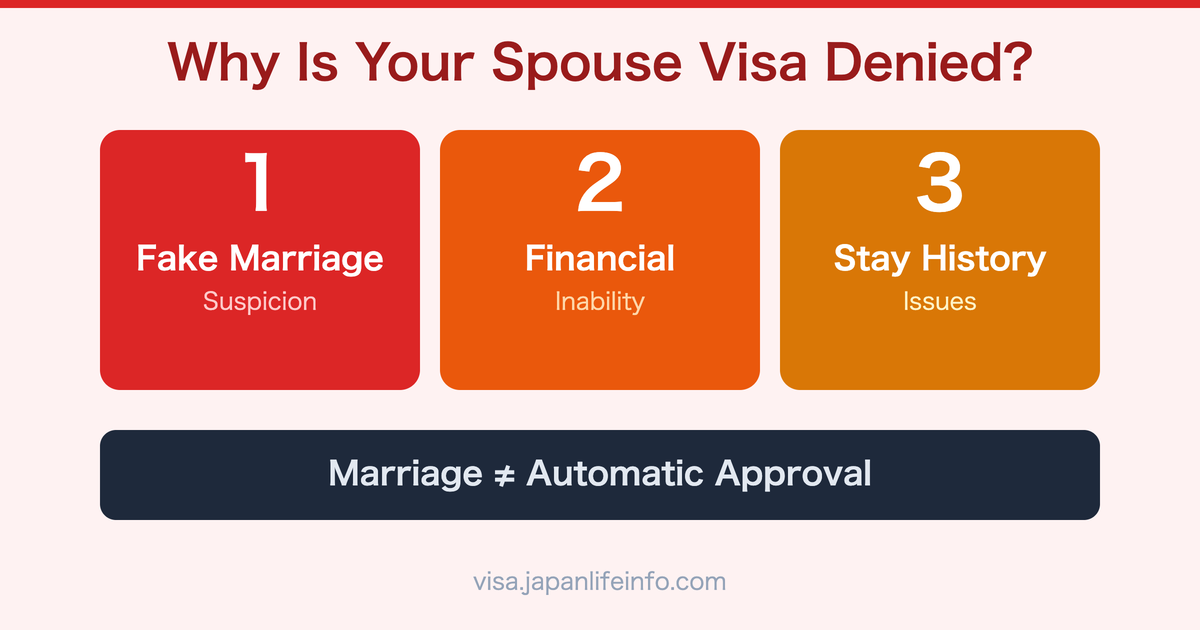
After an international marriage, cases where a Japanese spouse visa application is denied happen more often than you might expect.
The official name of the Japanese spouse visa is “Spouse or Child of Japanese National” (日本人の配偶者等) status of residence.
Today, we will outline the most common reasons for rejection that frequently occur in practice.
1. Suspected Fake Marriage (The Biggest Reason)
This is the most common reason for denial.
Immigration does not just look at whether a marriage is “legally registered” — they focus on whether it is a genuine and substantive marital relationship.
Cases That Easily Raise Suspicion
- Very short dating period
- Few in-person meetings
- Very large age gap
- Little to no common language
- No wedding ceremony or meeting between families
- Lack of SNS or messenger communication records
You will not be rejected simply because it is an international marriage, but “insufficient explanation” can lead to visa denial, so caution is necessary.
2. Insufficient Financial Ability
For a spouse visa, having a “stable living foundation” is an important review factor.
Immigration checks the following:
- Annual income of the Japanese spouse
- Tax certificates
- Job stability
- Tax arrears status
- Number of dependents
Risk Factor Examples
- Currently unemployed
- Income at welfare benefit level
- Tax delinquency
- Frequent job changes
Even if income is low, there is still a chance of approval if you provide a reasonable explanation of your living plan.
3. Past Stay History Issues
If the applicant has any of the following history, the review becomes significantly stricter.
- Overstay (illegal stay)
- Deportation history
- History of false applications
- Repeated short-term stay entries
- Criminal record or frequent legal violations
Overstay in particular is a significant disadvantage even for spouse visa applications.
4. Insufficient Documents
This happens in more cases than you might expect.
- Lack of photos together
- Poorly written relationship history statement
- No communication records
- Vague explanation of how the marriage came about
Immigration looks for “consistency in the story.”
For example:
- When did you first meet?
- How did you date?
- Why did you decide to get married?
If explanations are abstract or vague, suspicion is easily raised.
5. Living Separately or No Cohabitation Plan
A spouse visa is, in principle, a visa that assumes cohabitation.
The following situations are risky:
- Planning to live separately
- Long-term separation due to work
- Undecided residential address
If there are reasonable grounds, a proper explanation is required.
6. Tax and Pension Arrears
This is an area where reviews have become particularly strict in recent years.
- Resident tax arrears
- National pension non-payment
- Health insurance premium non-payment
This affects not only permanent residency applications but spouse visa applications as well.
What Is the Actual Rejection Rate?
Officially, the approval rate for spouse visas is relatively high, but when multiple suspicious factors overlap, the probability of denial increases sharply.
In particular:
- Short dating period
- Low income
- Large age gap
- Past stay history issues
If all four of these are present simultaneously, the risk is very high.
What Happens After Rejection?
- Possible immediate departure requirement
- Disadvantage when applying for other visas
- Reapplication is possible, but supplementary documents are essential
Review for reapplication after rejection is “stricter than the first time.”
Prevention Strategies
- Write a detailed and specific relationship history
- Organize photos in chronological order
- Review income and tax payment status
- Secure proof of cohabitation
- Honestly explain any past stay history issues
Conclusion
A spouse visa is not a visa that is automatically approved just because “you got married.”
The key is “genuineness” + “financial stability” + “clean stay history.”
If you are currently preparing your application, review your situation carefully, and if there are any risk factors, it is important to develop a strategy in advance.
Need to apply for or change your status of residence in Japan?
Easily create your Japanese status of residence application.