Things to Watch Out for When Using a Japan Visa Agency
When preparing for a Japanese work visa, spouse visa, Business Manager visa, or permanent residency, many people wonder whether to use a visa application agency.
First-timers in particular tend to have thoughts like these:
“Wouldn’t a professional handle it better?”
“Will using an agency guarantee my visa gets approved?”
“If it costs more, does that mean it’s more reliable?”
Plenty of people do use visa application services in Japan. That said, handing everything over to an agency does not automatically mean you’re safe, and there are things you should watch out for.
This article covers the key cautions to keep in mind when using a Japan visa application agency.
Visa agencies and Administrative Scriveners are not always the same
There is an important distinction to be aware of first.
In Japan, the qualifications required to act as a representative for immigration-related applications are strictly limited. Those authorized to handle such work include:
- Administrative Scrivener (gyoseishoshi)
- Certified specialist Administrative Scriveners for immigration procedures
Some businesses, however, operate without the proper legal credentials — offering only document preparation support or consulting rather than genuine representation.
It is important to clarify what type of business you are dealing with before proceeding. For guidance on when hiring an Administrative Scrivener makes sense, see When to Hire an Administrative Scrivener for Your Japan Visa Application.
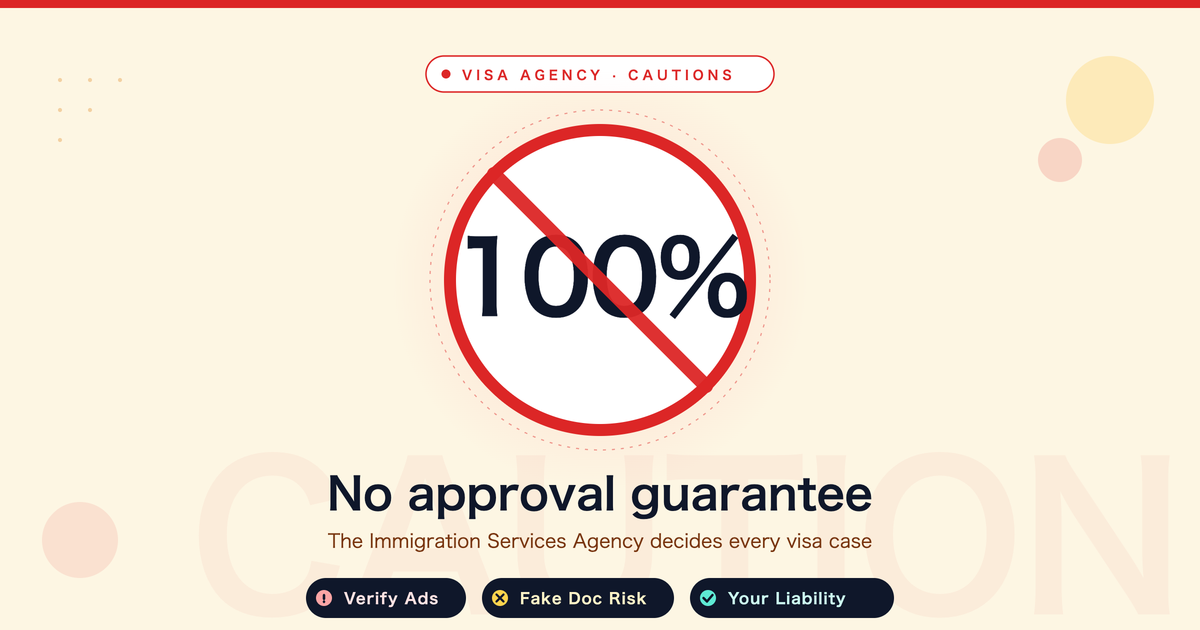
Beware of “100% approval guaranteed” claims
You may occasionally see advertisements with language like:
“100% visa approval rate”
“Approval guaranteed”
“Zero rejections on record”
In reality, Japanese visa decisions are made by the Immigration Services Agency. No agency can guarantee an outcome.
Claims like these are exaggerated and should be treated with skepticism.
Falsified documents are extremely dangerous
This is the most critical point to be aware of.
Some unscrupulous agencies, in an effort to get applications approved, may suggest:
- Fabricating work history
- Using a fake employment certificate
- Falsifying a business plan
- Inventing a relationship history
These approaches are extremely dangerous. Immigration can verify the authenticity of submitted documents, and if false information is discovered, the consequences may include:
- Visa denial
- Disadvantage in future applications
- Cancellation of your status of residence
Final responsibility rests with the applicant
This is something many people misunderstand.
Even if an agency prepared your documents, you as the applicant are ultimately responsible for the content that is submitted.
For example, if your application contains:
- Incorrect work history
- False information
- Descriptions that do not match the facts
simply saying:
“The agency wrote it that way”
will not make the problem go away.
Always review the full contents of your application yourself before submitting.
Watch out for unreasonably high fees
Costs vary depending on the type of visa.
However, some agencies charge far more than is reasonable given the scope of services they provide. For instance, charging excessive fees for what amounts to:
- Simply forwarding documents
- Filling out a basic application form
does happen. It is worth confirming in advance:
- Exactly what services are included
- Whether any additional fees may apply
Be cautious of suspiciously cheap agencies too
On the flip side, agencies that charge very little also warrant caution, as they may cut corners on:
- Consultation quality
- Document review
- Post-submission support
Rather than choosing based on price alone, look at actual track record and reliability as well.
Check whether they can handle additional document requests
During the visa review process, you may receive a request for additional documents.
How the agency responds at that stage matters just as much as the initial application. When choosing an agency, ask:
- Can they handle requests for additional documents?
- Will they provide consultation support during the review process?
For guidance on how to handle an additional document request, see How to Respond to an Additional Document Request During Japan Visa Review.
Don’t rely solely on online reviews
Many people make their decision based on reviews they find online. However, online reviews may include:
- Paid promotional reviews
- Sponsored testimonials
It is better to evaluate for yourself based on:
- The quality of the initial consultation
- How specifically they explain things
- How quickly they respond
Experience matters especially for permanent residency
The review process for permanent residency is more thorough than for a regular visa. It typically involves a comprehensive check of factors such as:
- Resident tax payments
- Pension contributions
- Health insurance enrollment
- Immigration records
It is worth verifying whether the agency or specialist has substantial experience with permanent residency applications.
Experience gaps can be significant for spouse visas
Visas related to international marriage often require you to explain:
- How you met and the history of your relationship
- The process leading to marriage
- Your living situation together
For this reason, it is worth checking whether the specialist has substantial experience handling spouse visa applications.
Questions to ask during your consultation
When consulting with an agency, it is a good idea to ask about the following:
- What are the expected risks in my situation?
- Have you had cases where additional documents were requested?
- Have you had any cases that were denied?
- Which documents are the most important?
A knowledgeable professional will not just tell you what you want to hear — they will explain the risks as well as the positives.
You don’t always need an agency
Depending on the visa type, many people do apply on their own. For example:
- Period of stay renewals
- Straightforward work visa renewals
are commonly handled without an agency.
On the other hand, applications for:
- Permanent residency
- Business Manager visa
- Complex spouse visa situations
often benefit from professional assistance.
Don’t believe claims of connections at Immigration
Some agencies claim things like:
“We have someone on the inside at Immigration”
“We’re connected to examiners”
Japanese visa reviews follow official procedures. Statements like these are nothing more than misleading sales talk and should be disregarded.
Frequently Asked Questions
Will using an agency improve my chances of getting a visa?
An agency can help you organize your situation and prepare documents, but it cannot guarantee approval.
Is an Administrative Scrivener required?
Not necessarily. Depending on your situation, you may be able to apply on your own.
What should I do if an agency offers to falsify documents?
It is extremely dangerous. Do not engage with them under any circumstances.
Do many people use agencies for permanent residency applications?
Yes. Permanent residency requires a large amount of documentation, so many applicants seek professional help.
Closing Thoughts
Visa application agencies can be genuinely helpful when it comes to navigating complex paperwork and procedures.
However, you should be wary of any agency that:
- Promises guaranteed approval
- Offers to falsify documents
- Uses exaggerated advertising claims
Above all, keep in mind that the final decision on any visa application rests with the Immigration Services Agency.
A trustworthy agency or Administrative Scrivener does not promise results — they analyze your current situation accurately, identify what documents are needed, and help you put together the strongest application possible.
If you are preparing a Japanese visa application, don’t evaluate agencies on price alone. Look at reliability, experience, and transparency of communication as well.
Recommended Reading
- Key Factors Japan Looks at When Screening Your Visa — A breakdown of what Immigration actually evaluates, not just agency advertising
- What Is Japan’s Immigration Services Agency? — The role and key duties of the body that makes the final call on visa decisions
- Benefits of Obtaining Permanent Residence from a Work Visa in Japan — Specific benefits of permanent residency and the key review criteria
Need to apply for or change your status of residence in Japan?
Easily create your Japanese status of residence application.