Can You Change from a Short-Term Visa to a Long-Term Visa in Japan?
If you are preparing to work in Japan, you may have asked yourself one of these questions:
“Can I just enter Japan on a tourist visa and switch to a work visa once I’m there?” “If I find a company during a short-term stay, can I change my status without leaving?”
These are among the most common questions people ask, and the answer may not be what you want to hear.
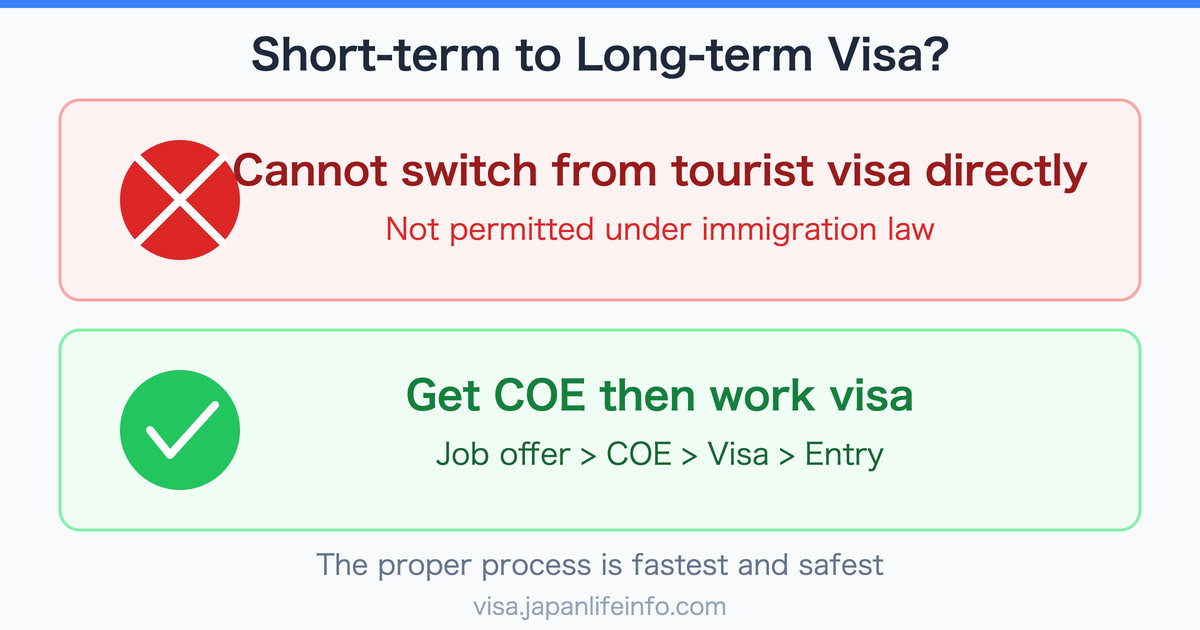
In principle, it is extremely difficult — and in most cases, it is virtually impossible.
What Is a Short-Term Visa (Short-Term Stay)?
The Japanese short-term visa, officially called “Short-Term Stay” (短期滞在), is a status of residence granted for temporary purposes such as:
- Tourism and sightseeing
- Visiting family or friends
- Short-term business trips (meetings, conferences — not employment)
The permitted duration of stay is typically 15 days, 30 days, or 90 days, depending on your nationality and the arrangements between your country and Japan.
The critical point to understand is that this status of residence does not permit any form of employment. It is designed exclusively for temporary visits with the expectation that you will leave Japan when your authorized stay expires.
The Principle: Short-Term to Long-Term Status Change Is Not Allowed
Under Japanese immigration law, the principle is clear:
A person who entered Japan on short-term stay status cannot, in principle, change to another status of residence from within Japan.
Why does this rule exist?
Short-term stay is granted on the premise that your visit is temporary. You entered Japan telling immigration that you would be there briefly — for tourism, a family visit, or a short business trip. If you then try to change to a long-term status like a work visa, the Immigration Services Agency may conclude that your original stated purpose of entry was not genuine.
In other words, if long-term intent is suspected, it can be treated as a violation of your entry purpose. This is a serious matter in Japan’s immigration system, which places enormous importance on the consistency between your declared purpose of entry and your actual activities.
Are There Any Exceptions?
Yes, but they are extremely limited and almost never apply to employment-related cases.
Humanitarian Reasons
In certain cases involving urgent humanitarian circumstances, a change of status from short-term stay may be permitted:
- Emergency marriage with a Japanese spouse — for example, if you entered Japan to visit your partner and an unexpected situation (such as pregnancy or a serious family matter) requires you to marry and remain in Japan
- Serious family circumstances — such as a close family member in Japan becoming critically ill and requiring your presence as a caregiver
- Childbirth — if you are about to give birth in Japan and cannot reasonably travel
These situations are evaluated on a case-by-case basis. You would need to demonstrate that the circumstances were genuinely unforeseeable and that requiring you to leave Japan would cause significant hardship.
Special Administrative Discretion
In very rare cases, the Immigration Services Agency may exercise discretion and allow a status change even outside the humanitarian categories. However, this is extraordinarily uncommon and is almost never applied to cases where someone entered on a tourist visa and then wants to switch to an employment-based status of residence.
If your situation is purely “I came as a tourist and found a job,” you should not expect this exception to apply.
The Correct Procedure for Getting a Work Visa
If you want to work in Japan legally, the proper process is as follows:
Step 1: Get hired by a Japanese company
Find and secure a job offer from a company in Japan. This can be done through job boards, recruiting agencies, networking, or even through interviews conducted during a tourist visit (more on this below).
Step 2: The company applies for a Certificate of Eligibility (COE)
Once you have a job offer, your prospective employer submits an application for a Certificate of Eligibility (在留資格認定証明書 / COE) to the regional immigration bureau in Japan. This document certifies that you meet the requirements for the specific work-related status of residence.
Step 3: COE is issued
Processing typically takes 1 to 3 months. Once approved, the COE is sent to either the company or to you.
Step 4: Apply for a work visa at a Japanese embassy or consulate in your home country
With the COE in hand, you go to the Japanese embassy or consulate in your home country (or country of residence) and apply for the actual work visa. With a valid COE, visa issuance is usually straightforward and takes about 1 week.
Step 5: Enter Japan with your work visa
You enter Japan with your new status of residence and can begin working legally.
The key takeaway: You do not change from a tourist visa to a work visa while inside Japan. Instead, you leave Japan, obtain the work visa abroad, and re-enter with the correct status.
What About Job-Seeking Activities on a Tourist Visa?
This is an important distinction that many people misunderstand.
Attending interviews: Allowed
You are permitted to attend job interviews, visit companies, and participate in recruitment activities while on a short-term stay visa. These are considered part of legitimate short-term business activities.
Starting work: Absolutely NOT allowed
Even if you receive a job offer during your tourist stay, you cannot begin working until you have obtained the proper work visa. Not even for one day. Not even “just to try it out.” Not even if you are not being paid yet (such as “training” or “orientation”).
Consequences of working without permission
Working without the appropriate status of residence constitutes illegal employment (不法就労). The consequences are severe:
- Deportation and a re-entry ban of 5 years or more
- A permanent mark on your immigration record
- Severe disadvantage in all future visa applications — even after the re-entry ban period ends, having a record of illegal work makes it far more difficult to obtain any Japanese visa
- Criminal penalties for the employer as well
A record of illegal work does not simply go away with time. It fundamentally damages your credibility in the eyes of Japanese immigration authorities.
Frequently Asked Questions
Q. I got hired while visiting Japan as a tourist. What should I do?
This is actually a common and manageable situation. The correct procedure is:
- Accept the job offer
- Have the company begin the COE application process
- Leave Japan before your short-term stay expires
- Once the COE is issued, apply for a work visa at a Japanese embassy in your home country
- Re-enter Japan with the work visa and start working
Do not attempt to stay in Japan and “wait it out.” Follow the proper procedure.
Q. If the COE arrives within 90 days, can I just wait in Japan and switch my status?
In principle, no. Even if the COE is issued while you are still in Japan on a short-term stay, you are generally expected to leave Japan, apply for the work visa at a Japanese embassy or consulate abroad, and re-enter with the correct status. Attempting to change status from within Japan while on short-term stay is almost always denied. Leaving the country and following the standard process is by far the safest and most reliable approach.
Q. Is it really that strict? I’ve heard of people who managed to change status from inside Japan.
While there may be anecdotal cases, these are rare exceptions that typically involve special circumstances (humanitarian reasons, etc.). Basing your plans on the hope that you will be one of these exceptions is risky. If your change of status application is denied, you will be required to leave Japan, and the denial itself may negatively affect future applications.
Why Does Japan Have This Rule?
Japan’s immigration system places great value on the consistency of your stated entry purpose.
When you enter Japan on a short-term stay visa, you are telling immigration: “I am here temporarily and I will leave.” If you then attempt to convert your status to a long-term work visa, it creates a contradiction. Immigration authorities may interpret this as evidence that you misrepresented your purpose of entry — which undermines trust.
This principle of consistency runs throughout Japan’s immigration framework. Maintaining a clean, honest, and consistent record with immigration authorities is one of the most important factors for anyone who wants to build a long-term life in Japan.
Conclusion
The “just go to Japan and figure it out” approach is one of the most common mistakes people make — and it can significantly increase your visa risk rather than reduce it.
The safe and reliable path to working in Japan is:
- Secure a job offer from a Japanese company
- Obtain a COE through your employer
- Apply for a work visa at a Japanese embassy in your home country
- Enter Japan with the correct status of residence
This process takes time, but it protects your immigration record and gives you the strongest possible foundation for your career in Japan. Cutting corners may seem tempting, but the potential consequences — deportation, entry bans, and a permanently damaged immigration record — are simply not worth the risk.
If you are serious about building a future in Japan, follow the proper procedure from the start.
Need to apply for or change your status of residence in Japan?
Easily create your Japanese status of residence application.